

In a nutshell
Across the MENAAP region, there are wide gender gaps in labour force entry, higher unemployment among women jobseekers, a concentration of employed women in public sector jobs, and large wage penalties, especially for the low skilled.
In economies such as Egypt, Jordan and Pakistan, removing the barriers that prevent women from joining the labour market could lift GDP per capita by 20-30% – the largest potential gains globally.
A comprehensive set of mutually reinforcing reforms would increase the availability of private sector jobs for women, remove legal and normative distortions, and reduce barriers related to mobility and childcare responsibilities.
The world region now known by the acronym MENAAP (the Middle East, North Africa, Afghanistan and Pakistan) stands at a pivotal moment amid shifting global economic conditions and persistent regional uncertainty, fragility and profound demographic transformation.
Its population of working age is projected to grow by about 220 million over the next quarter of a century – close to a 40% rise, the second largest across all regions (see Figure 1). But to date, MENAAP economies have failed to generate the jobs needed to capitalise on a once promising demographic dividend.
Figure 1: Changes in populations of working age across world regions, 2025-50
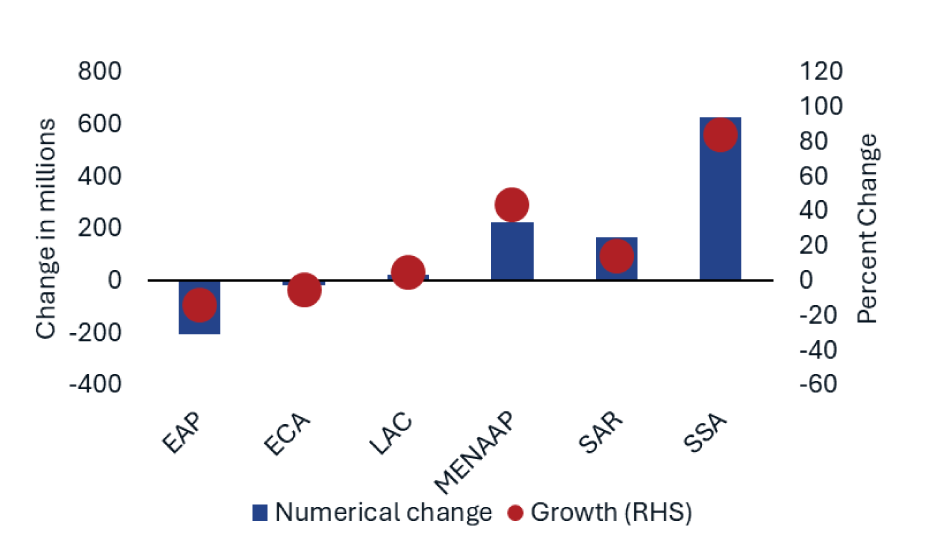
Note: Calculated using data from the UN Population Prospects (database), World Bank. EAP = East Asia and Pacific; ECA = Europe and Central Asia; LAC = Latin America and the Caribbean; MENAAP = Middle East, North Africa, Afghanistan and Pakistan; SAR = South Asia; SSA = Sub-Saharan Africa. Panel shows the change in the working-age population, using the benchmark method over the period 2025-50 by EMDE (emerging markets and developing economies) region, in absolute magnitude and as a percentage change on the right-hand side.
The rapidly rising old-age dependency ratios will soon strain GDP growth, fiscal balances and social protection systems. If current trends continue, there will be around 3.5 people in the labour force per elderly person by 2050. This is just above the danger zone – the ‘critical level 3’ where pension systems start sweating, fiscal balances start wobbling and policy-makers start losing sleep (see Figure 2).
Figure 2: Inverse dependency ratio in MENAAP
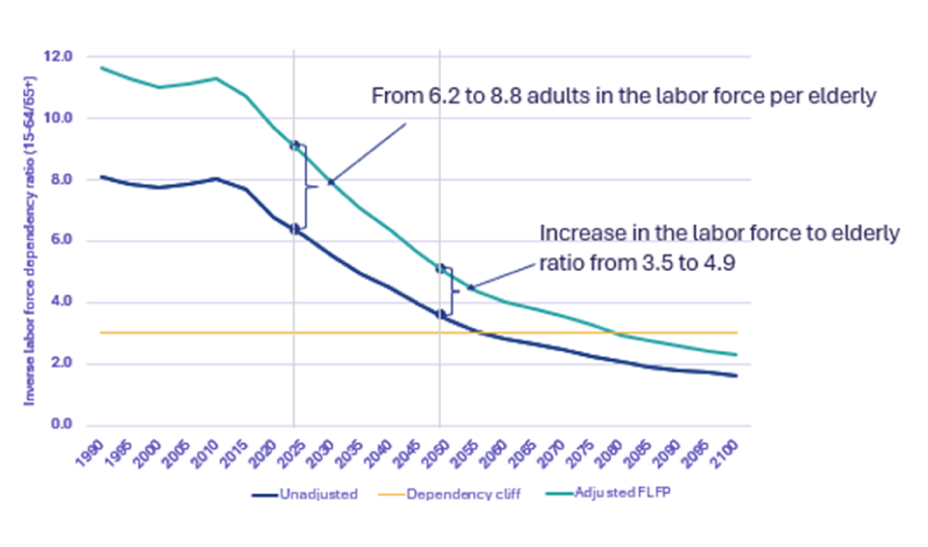
Note: Calculated using data from the UN Population Prospects and the International Labour Organization (ILOSTAT). The unadjusted labour force per elderly (blue) is the inverse dependency ratio computed as the ratio of the size of the labour force to the number of individuals 65 and older. The size of the labour force is calculated as the sum of each age specific labour force participation rate (sourced from ILOSTAT) multiplied by the population of each age category (sourced from the UN Population Prospects), calculated separately for each gender and country. The latest available labour force participation rate is used for all future projections. The size of the labour force is then divided by the size of the population 65+, as sourced from the UN Population Prospects. For the adjusted dependency ratio (green), the labour force participation rate for each five-year age group for women is the population-weighted average of labour force participation rates of other countries with the same World Bank income categorisation. Countries in the MENAAP and SAR regions were excluded when calculating the average rates of women’s labour force participation of income-peers. Rates of men’s labour force participation rates were left unadjusted.
Yet there is one lever that can bend this trajectory: expanding labour force participation among women. Despite enrolment and graduation rates comparable to or higher than those of men in most MENAAP countries, the average rate of women’s labour market participation in the region remains the lowest in the world (see Figure 3). Only about one in five women of working age participate in the labour market in the region.
Figure 3: Share of women (age 15+) in the labour force
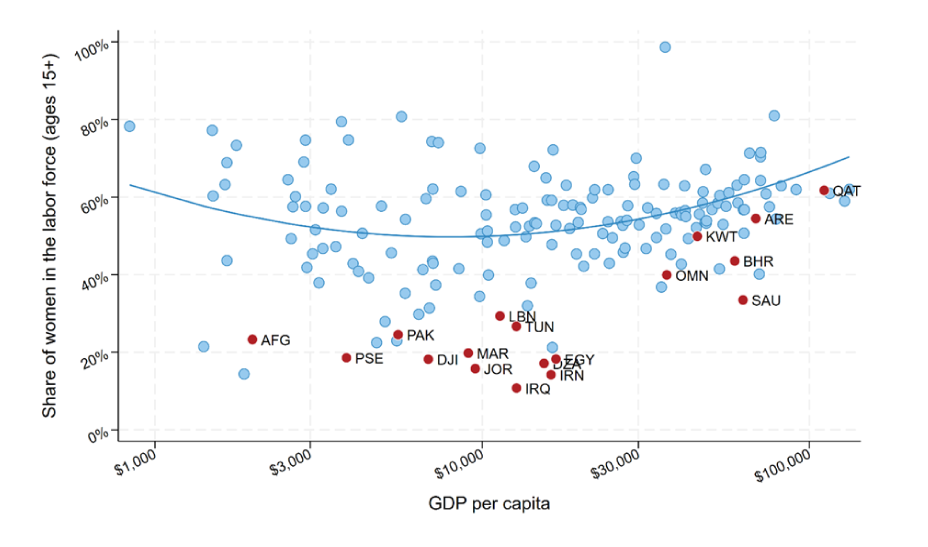
Note: Calculated using data from the International Labour Organization (ILOSTAT) and the World Bank’s World Development Indicators. Labour force participation rates for people 15 and older are from national estimates compiled by ILOSTAT. GDP per capita (PPP, constant 2021 international dollars) is from the World Bank’s World Development Indicators. The sample includes 176 countries, including 18 from the MENAAP region. Labour force participation rates and GDP per capita are matched using the latest available year for each country after 2013. The most recent data points for MENAAP countries are as follows: AFG (2021) ARE (2023), BHR (2015), DJI (2017), DZA (2017), EGY (2023), IRN (2023), IRQ (2021), JOR (2023), KWT (2016), LBN (2019), MAR (2022), OMN (2022), PAK (2021), PSE (2022), QAT (2022), SAU (2024), and TUN (2023). GDP per capita is shown in log scale. The blue fitted line shows the predicted quadratic relationship between labour force participation and log GDP per capita for the sample.
The low labour market participation of women is a result of a set of mutually reinforcing constraints (see Figure 4). Contextual factors, such as restrictive social norms and unequal laws, depress both women’s willingness and ability to work and employers’ demand. Social norms – often misperceived by individuals as even more restrictive than they actually are – remain more traditional than among global peers.
Many countries in the region still lack basic legal provisions for equal pay, flexible work, safe transport and protection from harassment, and in several cases, women cannot obtain jobs on the same terms as men. On the supply side, safety and mobility constraints – including concerns about harassment and unreliable transport – combined with unaffordable, inaccessible and inadequate childcare, make working outside the home costly for women. On the demand side, a stagnant private sector creates too few quality jobs.
Gender discrimination persists, particularly for customer-facing roles and in smaller firms. The public sector’s magnetic pull draws high-skilled women away from entrepreneurship and private sector careers.
Together, these forces produce a low-participation, low-growth equilibrium: wide gender gaps in labour force entry, higher unemployment among women jobseekers, a concentration of employed women in public sector jobs, and large wage penalties, especially for the low skilled.
Figure 4: Women’s labour force participation is shaped by the interaction between supply- and demand-side constraints and contextual distortions like restrictive social norms and legal barriers
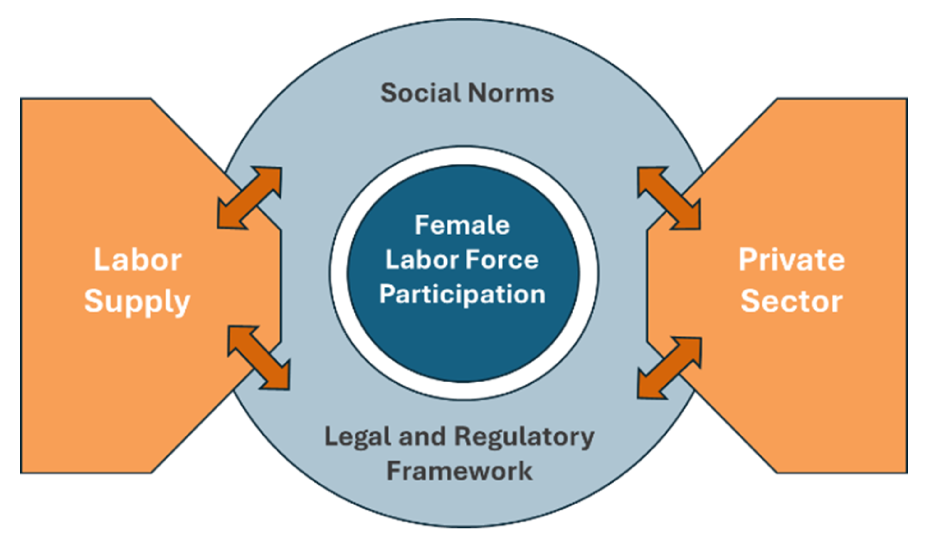
Note: Adapted from Carranza et al (2023).
Partial fixes will not suffice. Eliminating employer discrimination alone, for example, may deliver little if restrictive social norms around household roles and childcare remain binding. What is needed is a policy approach that acts on all fronts, with the region’s private sector functioning as the engine of job creation.
The macroeconomic stakes are high. In economies such as Egypt, Jordan and Pakistan, removing the barriers that prevent women from joining the labour market could lift GDP per capita by 20-30% – the largest potential gains globally.
The bottom line is straightforward: the region can no longer afford to leave half its human capital underused. Expanding women’s labour force participation is central to growth and resilience in the face of looming demographic change. The evidence is clear: the biggest payoffs come from comprehensive, mutually reinforcing reforms that increase the availability of private sector jobs, remove legal and normative distortions, and reduce barriers related to mobility and care responsibilities. The costs of inaction are rising, while the returns to bold, coordinated action are exceptional.