

In a nutshell
Dependence on small number of suppliers (import concentration) increases the vulnerability of cereal food security in MENA to external shocks; some countries are moving towards greater supplier concentration at precisely the time when geopolitical and climate risks are rising.
Exposure to internationally traded agricultural inputs represents a second layer of vulnerability, since disruptions in critical inputs can undermine domestic production.
Countries that rely on a more diversified range of cereal suppliers have shown greater flexibility in adjusting to the economic shock from the Russia-Ukraine war far better than those concentrated on a few partners.
Cereals are the backbone of diets in the Middle East and North Africa (MENA) region, with wheat alone accounting for more than half of total calorie intake in many nations. But the region’s arid climate, limited arable land and water scarcity constrain local agricultural production, making MENA heavily reliant on imports to meet domestic demand, despite being cereal producers and exporters.
The MENA region is one of the most food-import-dependent areas in the world, particularly for staple cereals such as barley, maize and wheat. But while import dependence is largely unavoidable given the region’s structural constraints, dependence on a limited number of foreign suppliers is not. Diversifying import sources has become an essential strategy for strengthening food security and improving resilience to geopolitical and climate-related disruptions.
Import concentration and dependence
In a previous article on The Forum, we showed how six MENA countries – Algeria, Egypt, Jordan, Lebanon, Morocco and Tunisia – are highly dependent on cereal imports, as they import between 43% and 99% of their cereal consumption needs (Karam et al, 2026).
While import dependence may take a longer time to adjust through increased productivity or land reclamation, and could also be unavoidable, reliance on a small number of supplying countries is not inevitable. One of the major sources of vulnerability to external shocks is a high import market concentration – that is, a country’s reliance on a small number of supplying countries for a product.
The Herfindahl-Hirschman index (HHI) is a commonly used measure of market concentration that helps assess the diversity of a country’s trade. We compute HHI for cereal imports at the HS 6-digit product level, covering the relevant products in Chapters 10, 11 and 19. For each product, the HHI is calculated as the sum of the squared shares of each supplying country in the importing country’s total imports of that product. A higher HHI therefore indicates greater concentration of imports among a smaller number of foreign suppliers, while a lower HHI indicates a more diversified supplier base.
A country with a perfectly diversified import portfolio will have an index close to zero, whereas a country will have a value of 1 if its imports are concentrated in a single source country/supplier (least diversified).
At the product level, the HHI is calculated separately for each HS-6 cereal product using the shares of source countries in that product’s imports. For the country-level figures, we calculate the value of total imports of cereal imports for all HS-6 products and the HHI is then calculated from each supplier’s share in the importing country’s total cereal imports.
Figure 1 reports the simple average and maximum of these annual country-level HHI over the period 2010-23. Egypt and Algeria exhibit the highest maximum HHI values (above 0.35), suggesting that their cereal imports were highly concentrated among few trading partners during that period. This reflects a potential vulnerability to supply disruptions.
Jordan and Lebanon show relatively high maximum values (above 0.30), though their mean HHIs are lower, indicating occasional spikes in concentration, but generally less import concentration than Algeria and Egypt. Morocco and Tunisia display lower mean and maximum HHIs, pointing to more diversified cereal import sources, although their maximum HHIs are between 0.2 and 0.25, and the average HHI values are between 0.15 and 0.2, highlighting moderate import concentration.
Import dependence alone does not necessarily imply vulnerability. Rather, vulnerability increases when imports are concentrated among only a few suppliers. Countries that source cereals from a broader range of trading partners are generally better positioned to absorb disruptions affecting any single exporter.
Figure 1: Herfindahl-Hirschman index by country (2010-23)
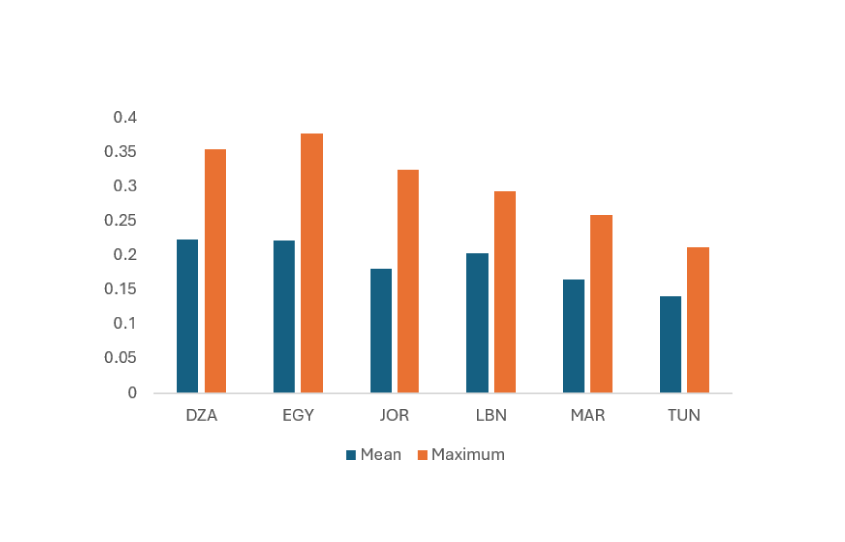
Notes: The mean refers to annual country-level HHI values averaged over the period 2010-23 (simple average); the maximum reports the highest annual value over the same period; DZA: Algeria; EGY: Egypt; JOR: Jordan; LBN: Lebanon; MAR: Morocco; TUN: Tunisia.
Figure 2 shows the HHI evolution between 2010 and 2023. Each panel includes a fitted trend line in red showing whether import concentration has increased or decreased over time.
Algeria and Morocco continue to reduce their import concentration, while Egypt, Jordan and Lebanon show increasing HHI values, reinforcing concerns about growing dependency on a narrow range of cereal suppliers (with some annual values more volatile). Tunisia, which ranked lowest in mean and maximum HHI in Figure 1, also shows a slightly increasing trend, meaning that several countries are moving towards rather than away from greater supplier concentration at precisely the moment when geopolitical and climate risks are rising.
Figure 2: Herfindahl-Hirschman index by country over time (2010-23)
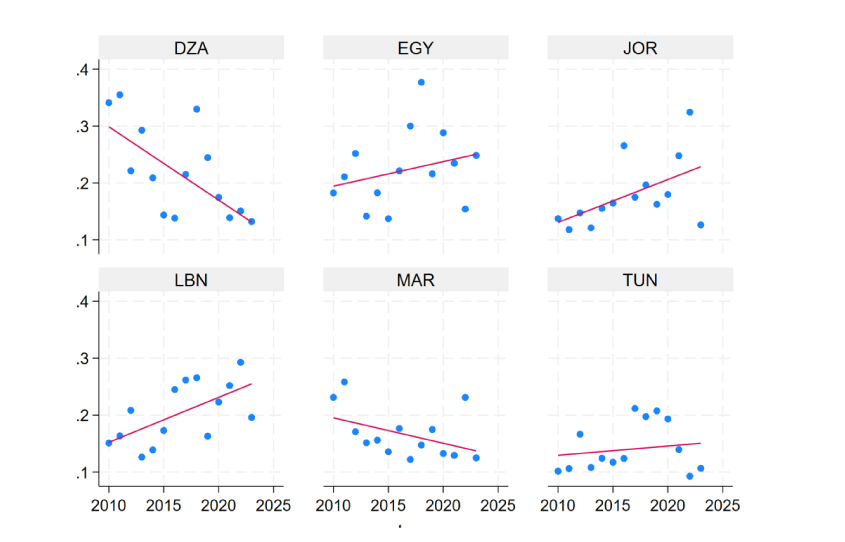
Note: DZA: Algeria; EGY: Egypt; JOR: Jordan; LBN: Lebanon; MAR: Morocco; TUN: Tunisia.
Exposure to imported agricultural inputs
Figure 3 displays countries’ average imports (in thousands of current US dollars) in four input categories: seeds, pesticides, fertilisers and machines – all of which are essential for modern food production and agricultural competitiveness. Absolute import values show the scale of countries’ exposure to internationally traded agricultural inputs, but do not by themselves measure import dependence. Assessing dependency would require comparison with domestic production or use.
Exposure to imported agricultural inputs represents a second layer of food-system vulnerability. Even if cereal imports are successfully diversified, disruptions in the supply of fertilisers, pesticides, improved seeds or agricultural machinery can reduce domestic production capacity and further increase dependence on imported food. Figure 3 should therefore be interpreted as an indicator of the scale of exposure to international input markets, rather than as a direct measure of import dependency.
Egypt and Morocco exhibit the highest import volumes across all four categories, indicating greater exposure in absolute terms to internationally traded agricultural inputs. But these values alone cannot establish greater import dependence because countries with larger economies or larger agricultural sectors would normally be expected to import more.
Similarly, the lower import values observed for Jordan and Lebanon do not by themselves indicate lower input dependence or a more domestic orientation. The figure therefore does not allow us to infer differences in modernisation, export orientation, technological reliance or domestic dependence from import volumes alone.
Nevertheless, disruptions in global markets for seeds, pesticides, fertilisers and machinery can affect domestic production capacity, making the resilience of input supply an important complement to cereal-import diversification.
Figure 3: Average of imports by country and input category (thousands of current US dollars)
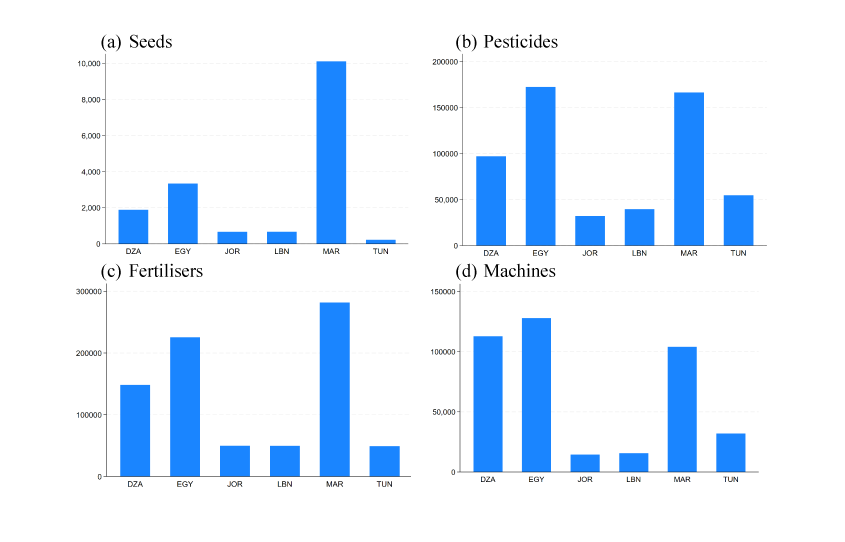
Notes: Figures are averages over the period 2010-23; DZA: Algeria; EGY: Egypt; JOR: Jordan; LBN: Lebanon; MAR: Morocco; TUN: Tunisia.
Import dependence and global shocks
The consequences of import concentration and dependence become apparent after geopolitical and climate crises. Based on calculations using value of cereal imports from the BACI database, in 2020, Russia and Ukraine supplied over two-thirds of Egypt’s, nearly half of Lebanon’s and 44% of Tunisia’s cereal imports before the 2022 invasion.
When the conflict devastated Ukrainian agriculture and blockaded Black Sea ports, the consequences for MENA importers were immediate and severe. By 2023, the value of Egypt’s cereal imports had declined by 28% relative to before the war, and Egypt increasingly sourced cereals from Bulgaria and Romania.
Tunisia, by contrast, saw the value of its cereal imports increase by 43% in 2023 by successfully pivoting to alternative suppliers to Ukraine, including Bulgaria, Romania and Russia. Lebanon occupied a middle ground, with Ukraine remaining its primary supplier but Russia dramatically expanding its market share from 7.55% to 14.95%.
These divergent outcomes suggest that countries with higher import concentration faced steeper shocks and had fewer options to stabilise supply. These country experiences are consistent with the proposition that greater sourcing flexibility can help countries to adjust to external shocks, although the extent of disruption also depends on domestic stocks, financing conditions, procurement systems, logistics and fiscal capacity.
Countries that had deliberately pursued diversification strategies before the crisis were better positioned to adjust. Algeria and Morocco are the only two among the six MENA economies that sourced at least 10% of their cereal imports from four different countries without allocating more than 24% to any single supplier. Algeria, in particular, shifted from 52% dependence on France in 2010 to a balanced portfolio where Argentina, Brazil, Bulgaria, Canada and Romania each supply significant shares.
Jordan and Tunisia have also achieved meaningful diversification by a different measure, with their top three trade partners together supplying less than 50% of total cereal imports; Jordan, for example, reduced its reliance on Russia and Ukraine in favour of Australia, Brazil, India and Romania.
But this broader spread of partners has not translated into a falling HHI for either country, both of which, as Figure 2 shows, are still trending towards greater concentration overall. This is because the share of the top ten cereal supplier countries increased significantly in both countries despite relying on different suppliers – from 62% in 2010 to 75% in 2023 for Jordan; and from 56% in 2010 to 80% in 2023 for Tunisia.
These trade vulnerabilities intersect with conflict risk across the region. The MENA region has been historically affected by geopolitical instability, civil unrest and armed conflicts, all of which pose significant challenges to its agricultural sectors, especially the cereal supply chain.
As a result, the resilience of the cereal supply chain in MENA is under significant stress due to the continuing conflicts and political instability. Even countries in the region not directly involved in conflicts are affected by external tensions through disrupted trade routes, fluctuating prices and regional instability.
Absorbing future shocks
The Russia-Ukraine war provided a real-world stress test of cereal import concentration across the six economies. The experience suggests that those with more diversified sourcing arrangements were generally better able to adjust when established supply channels were disrupted.
At the same time, the extent of disruption also depended on domestic stocks, financing conditions, procurement capacity, logistics and fiscal space. Supplier diversification should therefore be treated as an important, but not sufficient, component of food-security resilience.
For Egypt, Jordan, Lebanon and Tunisia, where HHI trends continue to rise, the priority should be to accelerate diversification across suppliers and geographical regions before the next disruption occurs, rather than relying on reactive adjustments once a shock has materialised. As geopolitical and climate-related risks intensify, diversification needs to form part of a broader resilience strategy combining trade, production, logistics, fiscal and social-protection measures.
Authors’ note: This column is part of the STAPLES (STable food Access and Prices and Lower Exposure to Shocks) project, which addresses critical issues of food security in the MENA region, where countries heavily rely on cereal imports for their population’s dietary needs. It is a PRIMA project funded by the European Union (EU).
Further reading
Aboushady, N, and C Zaki (2025) ‘Building sustainable food supply chains through trade policy in Western Asia and Northern Africa’, UNCTAD Development Account Project – 16th tranche, Geneva.
Bairati, L, Y Forouheshfar, F Karam, A Khafagy, D Moawad, P Pazos Puig, I Perez Borda, G Proglio, M Ruiz de Cossío, D Saccone and C Zaki (2026) ‘Resilience-enhancing trade policies reducing MENA dependency on non-Mediterranean countries’, STAPLES project, Deliverable 2.1.
Karam, F, A Khafagy and C Zaki (2026) ‘How trade policy can reduce MENA’s cereal import vulnerability’, The Forum, ERF.
Sandström, V, E Huan-Niemi, J Niemi and M Kummu (2024) ‘Dependency on imported agricultural inputs – global trade patterns and recent trends’, Environmental Research: Food Systems 1(1): 015002.
This column is part of the STAPLES (STable food Access and Prices and Lower Exposure to Shocks) project, which addresses critical issues of food security in the MENA region, where countries heavily rely on cereal imports for their population’s dietary needs. It is a PRIMA project funded by the EU.