

In a nutshell
Under trade sanctions, higher pre-existing corruption is associated with substantially greater conflict-related fatalities and political instability; the experiences of Iran and Assad-era Syria illustrate mechanisms consistent with the cross-country findings in the new study.
Sanctions can amplify pre-existing distortions rather than create them: a combination of high corruption, economic scarcity and visible inequality may intensify grievances and increase the risk of violent protest and political instability.
The effectiveness and human consequences of sanctions depend not only on the pressure imposed from outside, but also on the institutions through which that pressure is absorbed at home; sanctions design therefore requires careful assessment of country-specific governance conditions.
One of the central tools in the foreign policy of the United States and other major economic powers against targets in the Middle East and North Africa (MENA), such as Iran, Lebanon, Libya, Syria and Yemen, has been the use of economic sanctions (Morgan et al, 2023).
The attractive feature of this tool is rather clear from the sender’s perspective: sanctions promise leverage without the need for costly and risky military operations. But the outcomes of such economic pressures and their success rates are uncertain.
Sanctions have sometimes coincided with political transitions from autocratic structures towards more democratic and pro-Western regimes (perhaps the examples of Serbia in 2000 or South Africa in 1990-94), while in other cases they have coincided with strengthened authoritarian rule and radicalisation (like Iraq under Saddam Hussein, 1990-2003, or North Korea). They may also contribute to pathways towards armed conflict by increasing the risk of miscalculation by both the sender and the target of sanctions (the case of Iran, 2025-26; see also Farzanegan, 2026, on how sanctions can lower the threshold for war).
One lesson from these examples is that the association between sanctions and political stability or conflict may depend on the local institutions of target countries. The capacity of a state under sanctions to absorb shocks, including through control of information or the organisation and funding of repressive power, may shape how sanctions are absorbed and whether their stated aims are achieved (see Marinov, 2005; Allen, 2008; Escribà-Folch, 2010; Peksen, 2009).
Sanctions can also worsen domestic wellbeing by increasing poverty and inequality and weakening household resilience. These effects may intensify grievances and social pressures, thereby increasing the risk of political instability and conflict (Neuenkirch and Neumeier, 2016; Afesorgbor and Mahadevan, 2016; Farzanegan and Habibi, 2025; Haidar and Karimi, 2026).
Against this background, our focus is on one governance condition that may help to explain why sanctions produce such different outcomes across countries: pre-existing corruption.
Our study
In our recent study, we examine whether pre-existing political corruption changes the relationship between sanctions and subsequent conflict or political instability (Farzanegan and Alkurdi Albarawi, 2026). The analysis uses panel data for 122 countries over the period 1996-2020 and draws on the Global Sanctions Database (developed by Felbermayr et al, 2020).
Our main outcome is conflict-related deaths, with internal conflict-risk scores from Political Risk Services used as an additional measure. Corruption is captured using alternative indicators, including the V-Dem Political Corruption Index and the reversed World Bank Control of Corruption indicator, with higher values indicating greater corruption.
Although there is a strand of research that argues for the greasing effects of corruption and thus short-term positive effects on economic growth and the financing of co-optation (Fjelde, 2009), a larger share of empirical evidence points to the destructive effects of corruption and the sand-in-the-wheels argument, especially in the medium and long term (Aidt, 2009; Le Billon, 2003).
Corruption, defined as the misuse of public power for private benefit, increases inefficiencies within the economy, widens the gap between rich and poor, results in the misallocation of resources and talent, and amplifies the relative deprivation of people, especially marginalised groups, women and youth. A combination of a large youth population and higher corruption is particularly conducive to political instability (as shown by Farzanegan and Witthuhn, 2017).
In addition to sanctions, corruption, and their interaction term, which is our key explanatory variable of interest because it captures how corruption conditions the association between sanctions and conflict, we control for other drivers of conflict. These are income per person, oil rents, inequality, youth population, inflation, education, unemployment, media bias, egalitarian institutions and political regime characteristics.
Country and year fixed effects are also controlled for in the analysis. Country fixed effects account for factors that are fixed at the country level and may be important for political stability or conflict, such as geographical location, ethnic composition, culture or religious factors. Year fixed effects also control for time-specific shocks such as the global financial crisis or events like the COVID-19 pandemic in 2020, which has been shown to have resulted in more conflict in some countries (see Farzanegan and Gholipour, 2023, for empirical evidence).
We distinguish among trade, financial, military and arms sanctions and test whether their relationship with conflict and instability varies with the level of pre-existing corruption in the target country.
The results
Our findings show that corruption matters for the association between sanctions and conflict, with the clearest and most consistent evidence concerning trade sanctions and conflict-related outcomes. The results for financial sanctions and government instability are weaker.
At lower levels of corruption, the estimated relationship between trade sanctions and conflict deaths is negative or statistically indistinguishable from zero, depending on the corruption level. One possible interpretation is that economic pressure may be better absorbed in countries with greater state capacity, public trust and institutional resilience.
As an illustration, some relatively low-corruption countries have also been targets of trade restrictions imposed by Russia or China. For example, in 2014, Russia banned imports of a wide range of agricultural and food products from the European Union (EU), the United States, Canada, Australia and Norway.
These cases are illustrative and are not country-specific estimates from our model. By contrast, countries with relatively high levels of corruption in their public administration before the imposition of sanctions may already face a variety of inefficiencies in their economic systems, mistrust between the public and the state, and lower levels of social capital, all of which may weaken a country before sanctions arrive. The imposition of sanctions, of course, can also deepen corruption and rent-seeking within the system and expand the informal economy (Farzanegan, 2013).
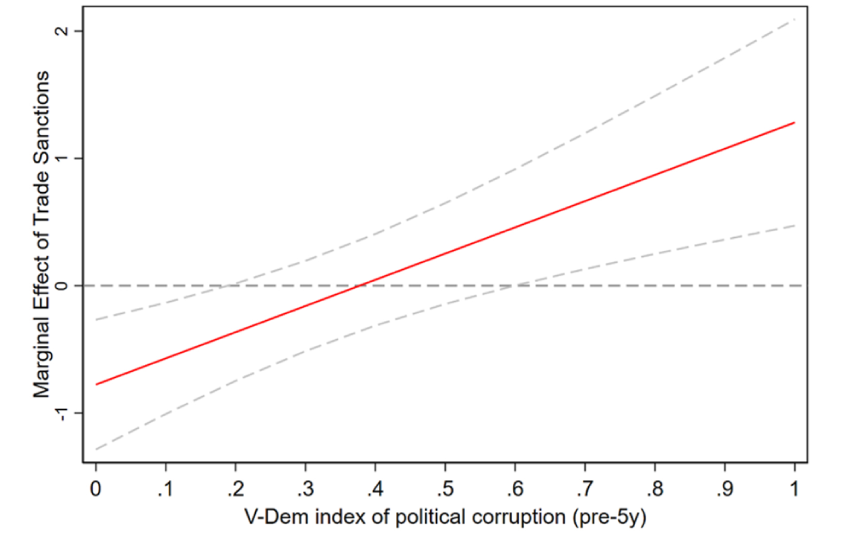
Figure 1 shows the marginal association between trade sanctions and conflict deaths at different levels of political corruption in previous years. At political corruption scores of around 0.6 and above (on a scale from 0 to 1), the estimated marginal association becomes positive and statistically significant: trade sanctions are linked with higher conflict deaths. In countries with lower levels of prior corruption, the relationship between trade sanctions and conflict is either statistically insignificant or negative.
At a corruption value of 0.6, the estimated marginal relationship is about 0.46 log points, corresponding to roughly 58% higher conflict deaths under trade sanctions. At the top of the corruption scale, the estimated difference reaches about 1.28 log points, equivalent to approximately 260% higher conflict deaths.
We also conducted multiple robustness checks that support this pattern. These tests include alternative transformations of conflict deaths, separate tests of whether conflict occurs and how intense it becomes, alternative corruption measures and lag structures, mean-centred interactions, different sender definitions, and specifications that account for overlap among sanction categories. Lead indicators for the three years before trade-sanction onset are individually insignificant, and their joint test is also insignificant. This reduces concerns that the trade result simply reflects a conflict trend already underway before sanctions began.
Figure 1. Average marginal effects of trade sanctions on In(conflict deaths+1) with 90% CIs
Why the results matter for Iran, Assad-era Syria and MENA
The cross-country estimates do not identify country-specific causal effects for Iran or Syria. Rather, these cases illustrate mechanisms that may become important when sanctions interact with pre-existing governance conditions.
Iran is particularly relevant because it is one of the most heavily sanctioned countries. As of early September 2026, external pressure had intensified further through both military and economic channels. A US naval blockade had significantly constrained Iran’s crude oil exports since mid-July, while on 24 August, the US Department of the Treasury launched Operation Economic Outcast, expanding its sanctions campaign against Iran and key trade partners, and warning third-country actors of possible secondary sanctions (Reuters, 2026; US Department of the Treasury, 2026).
There is substantial evidence that sanctions have adversely affected the Iranian economy (for a survey, see Farzanegan and Batmanghelidj, 2023). They restrict trade, raise the cost of production and imports, and reduce access to foreign exchange by constraining major sources of export revenue, including crude oil, petrochemicals, and other minerals. But the critical issue is not only the scarcity that sanctions create, but how that scarcity is governed and distributed.
In a highly corrupt system, politically connected firms and individuals may gain privileged access to scarce foreign exchange, public contracts, import channels and informal mechanisms for conducting international transactions. In Iran, such political connections can operate through the broader quasi-state corporate sector and through political, security, familial, or factional networks.
Sanctions can make these connections more valuable because they increase the rents associated with access to scarce resources. They can also expand the informal economy and create additional opportunities for rent-seeking (Farzanegan, 2013). Where transparency and the rule of law are weak, preferential access can deepen inequality and strengthen the role of intermediaries able to navigate or circumvent sanctions.
Importantly, corruption in Iran predates the current sanctions environment. The country’s political economy has long been shaped by the importance of oil rents, which can create opportunities for corruption where institutional checks are weak.
Evidence on the dynamic relationship between oil rents and corruption in Iran is provided by Farzanegan and Zamani (2025). Sanctions can therefore amplify pre-existing distortions rather than create them. The combination of high corruption, economic scarcity and visible inequality may intensify grievances and increase the risk of violent protest and political instability. Greater internet penetration may further reduce coordination costs and make inequalities and the wealth of groups benefiting from the system more visible (Farzanegan and Gholipour, 2026).
Assad-era Syria provides another illustration of how sanctions can interact with a pre-existing system of political connections and rent allocation. During the conflict, the regime relied heavily on politically connected business networks, warlords, and members of the Assad family, granting privileged access to resources and public projects in exchange for loyalty and support.
During the sanctions and conflict period, new politically connected beneficiaries also emerged (Friberg Lyme, 2012; Seeberg, 2015). Syria-specific research links these networks to the comparatively high resilience of the Assad regime.
At the same time, those networks contributed to the concentration of economic resources within a narrow circle and to the deterioration of formal economic activity (Siham, 2022; Yazigi, 2014). Declining public services, including electricity, water, and healthcare, together with rising inflation and unemployment, corruption, and trade sanctions, further aggravated popular grievances (Mehchy and Turkmani, 2021; Seeberg, 2015).
This discussion concerns Assad-era Syria. The sanctions architecture changed substantially following the fall of the Assad regime in December 2024. The United States terminated its main Syria sanctions programme effective 1 July 2025 while retaining targeted measures against Bashar al-Assad, his associates and other designated actors. The EU similarly removed broad economic sanctions in May 2025 while maintaining targeted measures against individuals and entities linked to the former regime; in May 2026, those targeted measures were extended until 1 June 2027 (US Department of the Treasury, 2025; Council of the European Union, 2026).
The Iran and Syria cases therefore illustrate mechanisms consistent with the cross-country findings rather than country-specific causal estimates. Where politically connected intermediaries capture scarcity rents, sanctions may weaken civilian welfare without proportionately weakening the state’s coercive capacity. Economic pressure can reinforce existing inequalities and rent-seeking structures, while generating grievances that do not necessarily translate into peaceful political transition.
Separate evidence for Iran similarly finds that stronger sanctions are followed by greater civil disorder and short-lived increases in terrorism risk, while different dimensions of conflict do not always move together (Farzanegan and Gutmann, 2025).
More broadly, institutional conditions differ substantially across MENA countries. Economies with stronger fiscal buffers, more capable public institutions and more effective social protection systems may be better able to cushion external economic shocks. By contrast, poorer or conflict-affected states with fragmented security institutions, weak social protection, high youth unemployment, or deep regional inequalities may be considerably more vulnerable.
Sanctions design therefore requires careful assessment of country-specific governance conditions rather than reliance on a single regional template.
Policy lessons
The strongest policy lesson from our study is that sanctions should not be designed independently of the governance conditions of the target country. Our evidence is strongest for trade sanctions: where pre-existing corruption is high, economic pressure is associated with substantially greater conflict-related deaths.
Sanctioning states should therefore define clear and narrow objectives and assess how proposed measures are likely to interact with local institutions, corruption and state capacity. Where the stated objective is compliance with specific international rules, including those related to nuclear activities, combining that objective with broader goals such as regime change or destabilisation can complicate both sanctions design and evaluation. Timing, targeting and the choice of sanctions instrument should therefore take account of the risk that economic pressure may aggravate conflict rather than advance the intended objective.
For target countries, governance is itself a source of resilience. Stronger state capacity, transparent resource allocation, credible anti-corruption measures, and fair access to scarce goods and foreign exchange can improve the ability of governments and societies to absorb external economic shocks. Where corruption allows politically connected groups to capture scarce resources, sanctions are more likely to deepen inequality, mistrust, and political fragility. Strengthening transparency and accountability is therefore not only a long-term governance objective; it can also reduce vulnerability to external economic pressure.
Writing about vulnerability to natural disasters, Ambraseys and Bilham (2011) observed that ‘corruption kills’. Our findings suggest that the warning may also apply to human-made shocks. Under trade sanctions, higher pre-existing corruption is associated with substantially greater conflict-related fatalities and political instability. The effectiveness and human consequences of sanctions therefore depend not only on the pressure imposed from outside, but also on the institutions through which that pressure is absorbed at home.
Further reading
Afesorgbor, SK, and R Mahadevan (2016) ‘The impact of economic sanctions on income inequality of target states’, World Development 83: 1-11.
Aidt, TS (2009) ‘Corruption, institutions, and economic development’, Oxford Review of Economic Policy 25(2): 271-91.
Allen, SH (2008) ‘The domestic political costs of economic sanctions’, Journal of Conflict Resolution 52(6): 916-44.
Ambraseys, N, and R Bilham (2011) ‘Corruption kills’, Nature 469: 153-55.
Council of the European Union (2026) ‘Syria: Council renews restrictive measures targeting the former al-Assad regime for one year and de-lists certain entities’, 18 May.
Dizaji, SF, and PAG van Bergeijk (2013) ‘Potential early phase success and ultimate failure of economic sanctions: A VAR approach with an application to Iran’, Journal of Peace Research 50(6): 721-36.
Escribà-Folch, A (2010) ‘Economic sanctions and the duration of civil conflicts’, Journal of Peace Research 47(2): 129-41.
Farzanegan, MR (2013) ‘Effects of international financial and energy sanctions on Iran’s informal economy’, SAIS Review of International Affairs 33(1): 13-36.
Farzanegan, MR (2026) ‘How sanctions can lower the threshold for war’, Global Policy Journal, 23 July.
Farzanegan, MR, and M Alkurdi Albarawi (2026) ‘Destabilizing the corrupt: Economic sanctions and their conflict-inducing consequences’, European Journal of Political Economy 95: 102885. https://doi.org/10.1016/j.ejpoleco.2026.102885
Farzanegan, MR, and E Batmanghelidj (2023) ‘Understanding economic sanctions on Iran: A survey’, The Economists’ Voice 20(2): 197-226.
Farzanegan, MR, and HF Gholipour (2023) ‘COVID-19 fatalities and internal conflict: Does government economic support matter?’, European Journal of Political Economy 78: 102368.
Farzanegan, MR, and HF Gholipour (2026) ‘Internet, inequality, and regime stability’, Scottish Journal of Political Economy 73(2): e70041.
doi:10.1111/sjpe.70041.
Farzanegan, MR, and J Gutmann (2025) ‘Intensity of international sanctions and internal conflict: The case of Iran’, ERF Working Paper No. 1786.
Farzanegan, MR, and N Habibi (2025) ‘The effect of international sanctions on the size of the middle class in Iran’, European Journal of Political Economy 90: 102749.
Farzanegan, MR, and S Witthuhn (2017) ‘Corruption and political stability: Does the youth bulge matter?’, European Journal of Political Economy 49: 47-70.
Farzanegan, MR, and R Zamani (2025) ‘Oil rents shocks and corruption in Iran’, Review of Development Economics 29(2): 887-916.
Felbermayr, G, A Kirilakha, C Syropoulos, E Yalcin and YV Yotov (2020) ‘The global sanctions data base’, European Economic Review 129: 103561.
Fjelde, H (2009) ‘Buying peace? Oil wealth, corruption and civil war, 1985-99’, Journal of Peace Research 46(2): 199-218.
Friberg Lyme, R (2012) ‘Sanctioning Assad’s Syria: Mapping the economic, socioeconomic and political repercussions of the international sanctions imposed on Syria since March 2011’, DIIS Report 2012:13, Danish Institute for International Studies.
Haidar, JI, and SM Karimi (2026) ‘Sanctions and household welfare: Evidence from Iran’, The World Economy: 1-44.
Laudati, D, and MH Pesaran (2023) ‘Identifying the effects of sanctions on the Iranian economy using newspaper coverage’, Journal of Applied Econometrics 38(3): 271-94.
Le Billon, P (2003) ‘Buying peace or fuelling war: The role of corruption in armed conflicts’, Journal of International Development 15(4): 413-26.
Marinov, N (2005) ‘Do economic sanctions destabilize country leaders?’, American Journal of Political Science 49(3): 564-76.
Mehchy, Z, and R Turkmani (2021) ‘Understanding the impact of sanctions on the political dynamics in Syria’, Conflict Research Programme, London School of Economics and Political Science.
Morgan, TC, C Syropoulos and YV Yotov (2023) ‘Economic sanctions: Evolution, consequences, and challenges’, Journal of Economic Perspectives 37(1): 3-30.
Neuenkirch, M, and F Neumeier (2016) ‘The impact of US sanctions on poverty’, Journal of Development Economics 121: 110-19.
Peksen, D (2009) ‘Better or worse? The effect of economic sanctions on human rights’, Journal of Peace Research 46(1): 59-77.
Reuters (2026) ‘Blockade succeeds where sanctions failed as Iran oil exports stall’, 1 September.
Seeberg, P (2015) ‘The limits to the sanctions regime against Syria’, in On Target? EU Sanctions as Security Policy Tools, European Union Institute for Security Studies, 67-74.
Siham, A (2022) ‘The role of the Syrian business elite in the Syrian conflict: A class narrative’, British Journal of Middle Eastern Studies 49(3): 433-45.
US Department of the Treasury (2025) ‘Treasury implements President’s termination of Syria sanctions’, 30 June.
US Department of the Treasury (2026) ‘Treasury launches unprecedented campaign against Iranian regime on Economic D-Day’, 24 August.
Yazigi, J (2014) ‘Syria’s war economy’, European Council on Foreign Relations.