

In a nutshell
While women had lower employment rates and were more likely to exit work during the pandemic, these patterns appear to be continuations of trends in MENA from prior to Covid-19; women and men have experienced similar recoveries in employment rates.
Although married women with children had lower employment rates during the pandemic, this too was a continuation of pre-pandemic trends: taking account of pre-pandemic labour market status, women with children were not more likely to exit work following school closures.
The experience of the pandemic underscores the persistent gender inequality in unpaid care work in MENA, and the necessity of redressing gender norms underlying this inequality to allow women equal employment opportunities.
The MENA region had the world’s largest gender disparity in unpaid care work before the Covid-19 pandemic (International Labour Organization, 2018), raising concerns that closures of schools and child care facilities would disproportionately affect women’s employment and wellbeing.
Figure 1 shows school operating status during the dates of COVID-19 MENA Monitor data collection (OAMDI, 2021), based on the UNESCO global monitoring of school closures database (UNESCO, 2021) and news reports. While schools were sometimes open in person, they were also often only open with partial capacity (for example, only operating some days of the week), online only or totally closed.
Married women in households with young and school-aged children reported increased direct care work (time spent taking care of children) during the pandemic compared with pre-pandemic (February 2020), as shown in Figure 2. Among women living in households with children, across countries, while 23-35% of women who were unmarried reported more care work, 39-48% of married women reported more care work.
Figure 1: Operating status of schools by country and date
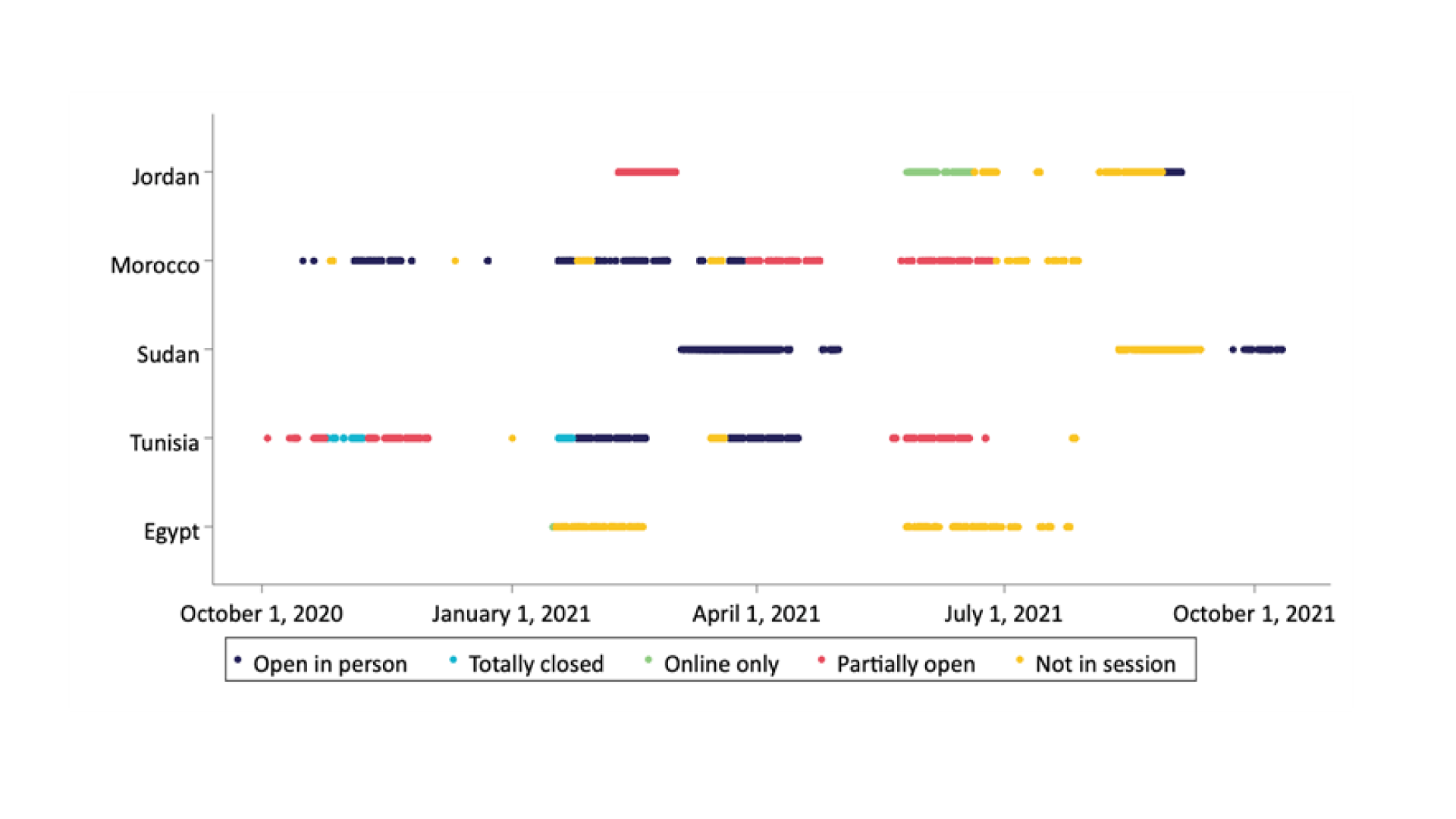
Source: Krafft et al. (2022) based on school closures data
Notes: Showing weeks with survey observations in the COVID-19 MENA Monitor data, all waves.
Figure 2: Direct care work in the past week versus February 2020 (percentage), by country and marital status, women in households with children aged 18 or younger
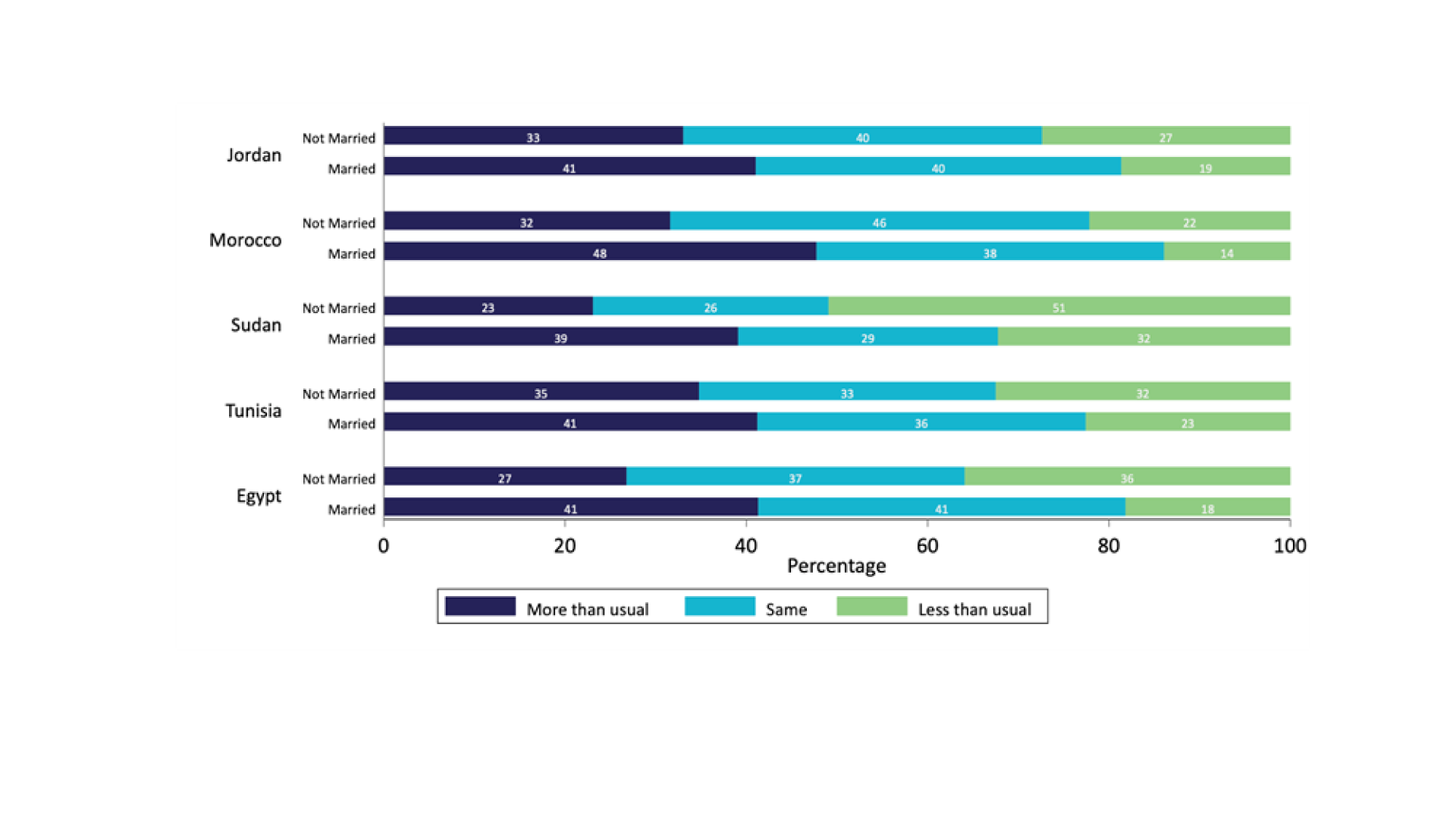
Source: Krafft et al. (2022) based on the COVID-19 MENA Monitor, all waves.
In analyses examining the impact of school closures (as shown in Figure 1) on whether women reported more care work (the outcome shown in Figure 2), among those women with school-age children, total closures of schools increased reports of more care work (Krafft et al., 2022).
But unlike in higher-income countries (Collins et al., 2021), online schooling actually led to reports of less care work in MENA (Krafft et al., 2022). This may be because online schooling provided some child care and education, but with a lighter workload for parents (for example, no homework). Youth in Jordan, for example, reported a lighter workload with online schooling (Assaad et al., 2021).
Married women with children had already selected out of types of work that were difficult to reconcile with care responsibilities
During the pandemic, married women with children had lower employment rates than unmarried women or married women without school-age or younger children in most countries (Krafft et al., 2022). But this pattern appears to be a continuation of pre-pandemic trends, as women tend to exit employment at marriage in MENA (Krafft and Assaad, 2020; Selwaness and Krafft, 2021; Assaad et al., 2022).
Likewise, although women in MENA had high rates of exit from employment during the pandemic, this appears to be a continuation of pre-pandemic trends of high rates of exit by women (Krafft et al., 2022). Our analysis demonstrates that after accounting for pre-pandemic labour market status, women with children did not differentially exit employment. Similarly, school closures did not directly affect women’s employment exits.
Part of the reason that married women with children did not experience a differential impact of the pandemic may be that they had already selected out of forms of employment (particularly private sector wage work) that were difficult to reconcile with care-giving.
In Egypt, Jordan and Tunisia, married women with children who worked were disproportionately in the public sector, where employment protections and working conditions made care and employment easier to reconcile. In Morocco and Sudan, married women with children who worked tended to be in non-wage (often agricultural) work pre-pandemic.
Policy implications
Women with children had low employment rates and women often exited employment during the pandemic. But these patterns appear to be primarily continuations of pre-existing trends rather than impacts of Covid-19. While women’s care work increased due to school and child care closures, married women with children had already largely selected out of the types of work (especially private sector wage work) that were difficult to reconcile with care responsibilities.
These findings underscore the persistent gender inequality that exists in unpaid care work in MENA and the necessity of redressing gender norms underlying this inequality to allow women equal employment opportunities. For example, in Egypt, 98% of men agree that ‘Changing diapers, giving baths to children, and feeding children should all be the mother’s responsibility’ [emphasis added] (El-Feki et al., 2017). Care work must be recognised, reduced and especially redistributed in the MENA region (ERF and UN Women, 2020).
Note: This column is based on ‘Employment and Care Work during the COVID-19 Pandemic: Persistent Inequality in the Middle East and North Africa’, ERF Policy Brief No. 78 by Caroline Krafft, Ilhaan Omar, Ragui Assaad, Ruby Cheung, Ava LaPlante, Mohamed Ali Marouani, Irene Selwaness and Maia Sieverding. The underlying research is presented in ‘The Impact of the COVID-19 Pandemic on Women’s Care Work and Employment in the Middle East and North Africa’, ILO/ERF Working Paper by Caroline Krafft, Irene Selwaness and Maia Sieverding.
Further reading
Assaad, Ragui, Caroline Krafft and Irene Selwaness (2022) ‘The Impact of Marriage on Women’s Employment in the Middle East and North Africa’, Feminist Economics.
Assaad, Ragui, Caroline Krafft, Maia Sieverding, Layla Al-Hajj, Ruby Cheung, Adriana Cortes Mendosa, Amalea Jubara, Kai Tiede and Sarah Wahby (2021) ‘Youth Transitions to Adulthood in Jordan: High Aspirations, Challenging Realities’, UNICEF.
Collins, Caitlyn, Liana Christin Landivar, Leah Ruppanner and William Scarborough (2021) ‘COVID-19 and the Gender Gap in Work Hours’, Feminist Frontiers 28(S1): 101-12.
ERF and UN Women (2020) ‘Progress of Women in the Arab States 2020: The Role of the Care Economy in Promoting Gender Equality’, UN Women.
El-Feki, Shereen, Brian Heilman and Gary Barker (eds) (2017) Understanding Masculinities: Results from the International Men and Gender Equality Survey (IMAGES) – Middle East and North Africa. UN Women and Promundo-US.
International Labour Organization (2018) Care Work and Care Jobs for the Future of Decent Work.
Krafft, Caroline, and Ragui Assaad (2020) ‘Employment’s Role in Enabling and Constraining Marriage in the Middle East and North Africa’, Demography 57: 2297-2325.
Krafft, Caroline, Irene Selwaness and Maia Sieverding (2022) ‘The Impact of the COVID-19 Pandemic on Women’s Care Work and Employment in the Middle East and North Africa’, ILO/ERF Working Paper.
OAMDI (2021) ‘COVID-19 MENA Monitor Household Survey (CCMMHH)’, Version 5.0 of the Licensed Data Files; CCMMHH_Nov-2020-Aug-2021, retrieved 30 November 2021.
Selwaness, Irene, and Caroline Krafft (2021) ‘The Dynamics of Family Formation and Women’s Work: What Facilitates and Hinders Female Employment in the Middle East and North Africa?’ Population Research and Policy Review 40(3): 533-87.
UNESCO (2021) Education: From Disruption to Recovery.