In a nutshell
As climate change, geopolitical uncertainty and supply chain disruptions continue to reshape global food markets, MENA countries will need to move beyond crisis management towards long-term resilience.
An inclusive trade policy balances multiple objectives: ensuring affordable access to food, supporting domestic producers, diversifying import sources, reducing trade costs and strengthening the resilience of food supply chains to future shocks.
Together, measures to achieve these objectives would help to transform trade policy from a short-term crisis response into a long-term strategy for strengthening food security and reducing MENA's vulnerability to external shocks.
Food security has become one of the most pressing policy challenges in the Middle East and North Africa (MENA). Over the past two decades, major shocks – such as the food crisis of 2007-08, the Covid-19 pandemic and the war between Russia and Ukraine – have exposed the region’s vulnerability to disruptions in global food markets. Heavy dependence on imported cereals, combined with climate change, water scarcity and geopolitical uncertainty, continues to threaten food resilience across the region.
This is why trade policy can play a key role in making food security more resilient. In this context, an inclusive trade policy is one that balances multiple objectives simultaneously: ensuring affordable access to food for consumers; supporting domestic producers through productivity-enhancing measures; diversifying import sources; reducing trade costs; and strengthening the resilience of food supply chains to future shocks.
Structural dependence on cereal imports
MENA is among the world regions that are most dependent cereal imports. Of the six countries that we study in Bairati et al (2026), Jordan imports 99% of its cereal consumption needs, while Lebanon imports 87%, Algeria 81%, Morocco 74% and Tunisia 72%. The least dependent country is Egypt (43%): despite being the largest cereal importer in absolute terms, it produces part of its cereal needs domestically. Figure 1 illustrates the scale of the region’s dependence, with most MENA countries importing well over 70% of their cereal needs.
Figure 1: Cereal import dependency ratio (percentage, three-year average)
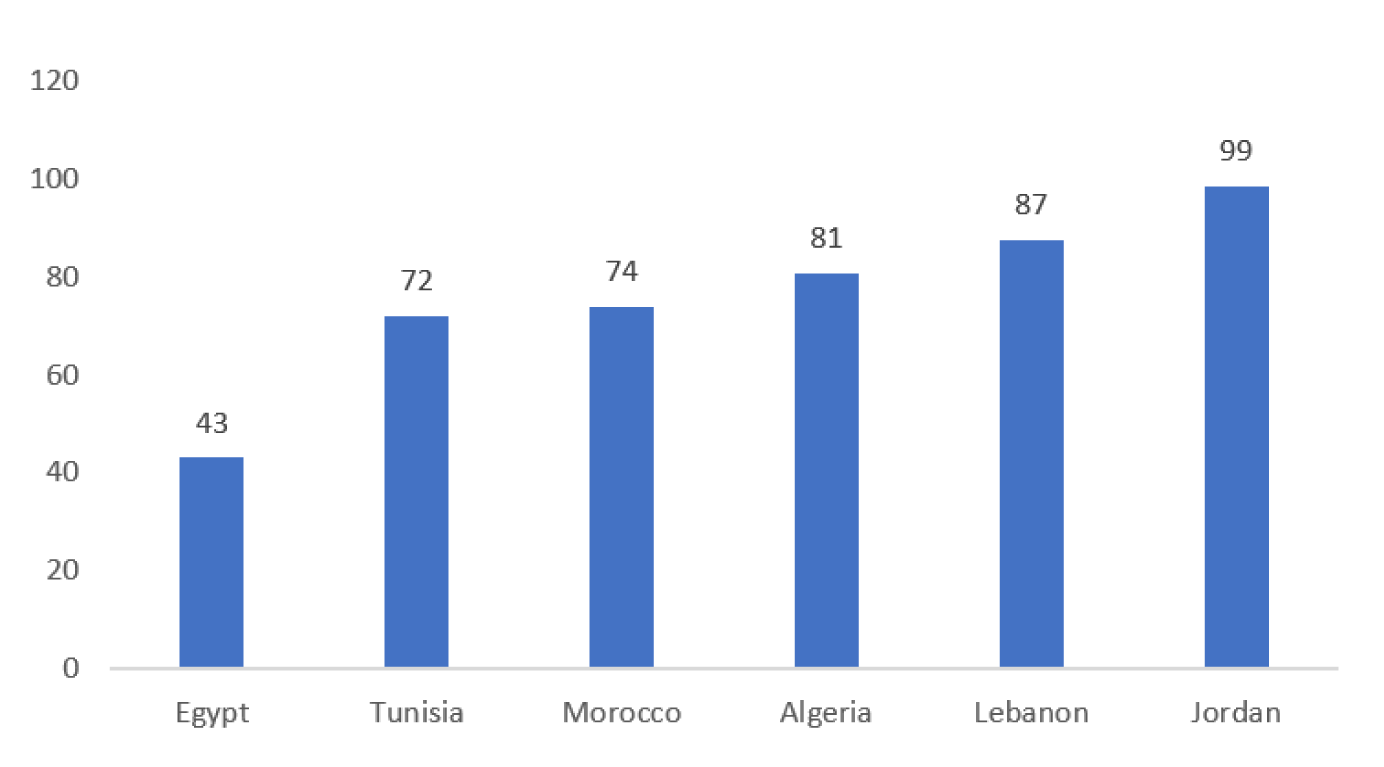
The import dependency ratio (IDR) is defined as imports/(production + imports – exports) x 100.
This dependence reflects structural constraints, including limited arable land, scarce water resources, rapid population growth and increasing climate pressures. In Egypt, for example, agriculture depends overwhelmingly on the Nile river, which provides 96% of the country’s water resources. Yet more than 80% of available water is already used in agriculture, limiting the possibility of large-scale cereal expansion.
At the same time, MENA countries are exposed to concentrated import sources. Before Russia’s full-scale invasion of Ukraine, countries such as Egypt, Lebanon and Tunisia relied heavily on Russian and Ukrainian wheat. When the war disrupted supply chains and Black Sea exports, governments were forced to diversify suppliers towards Brazil, Bulgaria, Canada and Romania,
Trade restrictions on cereal imports: why an inclusive policy design matters
In the presence of such vulnerabilities, trade policy plays a critical role in determining the affordability, availability and stability of food supplies. Historically, governments in the region have relied on subsidies, price controls, tariff reductions, export restrictions and strategic food reserves to protect consumers during periods of crisis.
For example, during the food crisis of 2007-08, Egypt imposed rice export bans and reduced import tariffs on basic food products such as rice, sugar and milk. Following the Russia-Ukraine war, the government expanded wheat reserves and increased support to domestic wheat farmers through subsidies and investments in irrigation and agricultural technology. These measures have often been effective in preventing shortages and social unrest. But long-term resilience requires moving beyond emergency responses towards policies that strengthen the underlying capacity of food systems.
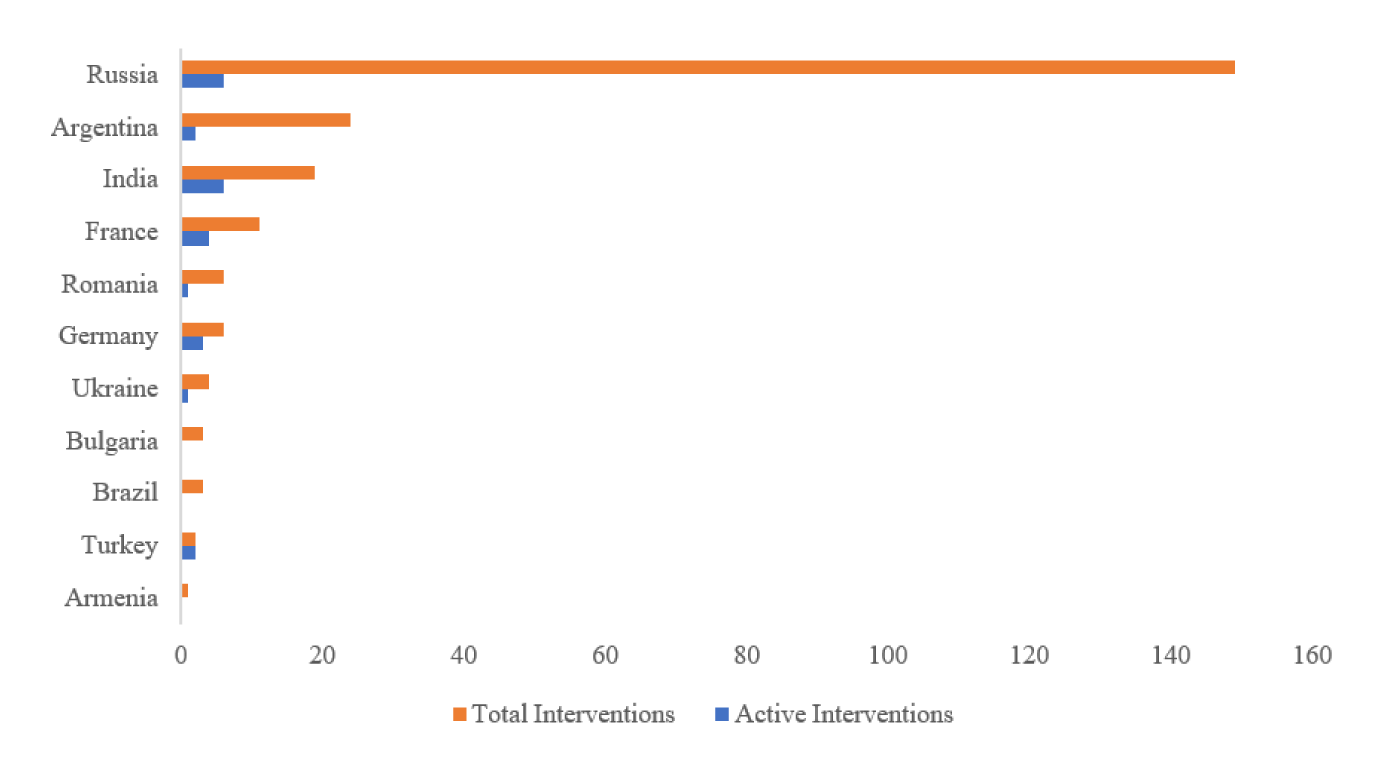
Yet non-tariff barriers (NTBs) imposed by main trade partners further exacerbate the vulnerability of the cereal food system in the region. As Figure 2 shows, the main cereal exporters introduced over 220 trade interventions between 2020 and 2025, overwhelmingly concentrated in Russia at the height of the war. Russia alone imposed 115 export-related policies between 2022 and 2024, including export taxes, bans and tighter licensing that had a strong and immediate effect on cereal supply to a region already heavily dependent on imports. By contrast, alternative suppliers such as Brazil, Bulgaria and Romania refrained from imposing heavy trade barriers on their cereal exports, which explains why MENA importers turned to them during the Russia-Ukraine war.
Figure 2: Number of interventions imposed by main cereal exporters (2020-25)
A more inclusive trade policy should balance food affordability with support for domestic agriculture. While high tariffs may protect farmers and local processing industries, they can also raise food prices in countries that depend heavily on imported cereals.
Our report (Bairati et al, 2026) reveals substantial tariff variation across MENA countries: Algeria and Morocco apply some of the highest average cereal tariffs in the region, at around 20%, while Tunisia’s average cereal tariff is close to 10%.
In contrast, Egypt and Jordan follow the most liberal approach, with an average tariff of only 1% or sometimes 0%. Tariff protection also increases with the level of processing, reflecting efforts to encourage domestic value added.
While many countries maintain low tariffs on primary cereals such as wheat and maize to ensure food affordability, higher tariffs are often applied to processed cereal products, including flour, pasta and bakery products, particularly in Algeria, Morocco and Tunisia.
Rather than relying on border protection, governments should improve agricultural productivity through investments in irrigation, climate-smart agriculture, technology adoption, research and access to finance. Such measures enhance farmers’ competitiveness while maintaining affordable food supplies.
An inclusive trade policy must also address NTBs, which increase the cost of food trade. Regulations related to food safety and quality are essential, but complex procedures, duplicative inspections and inconsistent standards can create unnecessary obstacles, particularly for smaller producers.
Examples of NTBs affecting cereal trade include Algeria’s requirement that imported cereals be accompanied by certificates confirming that plant materials are non-genetically modified, Egypt’s requirement for aflatoxin testing certificates and compliance with Egyptian Standard 1601 on grain quality, and Jordan’s use of pre-import clearance procedures and import restrictions related to sanitary or phytosanitary (SPS) concerns. Streamlining customs procedures and harmonising standards can reduce compliance costs while preserving consumer protection.
Food resilience depends not only on trade policies themselves, but also on the services that support trade. Efficient transport, logistics, finance, insurance, telecommunications and customs systems are essential for ensuring that food moves quickly and reliably across borders. Yet barriers in these sectors remain significant across much of the region, increasing transport costs and reducing supply chain flexibility during crises.
For example, in Bairati et al (2026), we argue that the estimated barriers to maritime transport services reach 79% in Egypt, 78% in Lebanon, 75% in Tunisia and 73% in Morocco. Restrictions are also high in rail transport (84% in Algeria, Egypt, Jordan and Lebanon) and legal services (73% in both Egypt and Jordan). Investments in logistics infrastructure and digital customs systems can significantly reduce import costs and improve market efficiency.
The role of regional and Mediterranean trade integration
Regional trade integration remains a largely untapped reservoir for improving cereal trade efficiency and food security in the region. Although MENA countries participate in agreements such as the pan-Arab free trade area (PAFTA) and, for some, the Agadir agreement, these frameworks remain shallow and are mainly limited to tariff reductions, with sensitive products like cereals still partially protected.
More importantly, NTBs, inefficient customs procedures and restrictions in services such as transport, logistics and finance continue to hinder trade flows significantly. While agreements centred on the European Union (EU) tend to be deeper and include broader provisions on services, regulation and standards, intra-MENA cereal trade remains extremely limited, leaving countries heavily dependent on external suppliers. As a result, regional cereal trade shares remain very low across the region, reflecting weak integration and missed opportunities for collective resilience.
This is confirmed by Figure 3, which shows that preferential trade agreements (PTAs) involving non-Arab exporters tend to be deeper and more comprehensive than those signed with Arab partners. These agreements generally include a higher number of legally enforceable provisions, especially in areas that go beyond traditional tariff reduction.
Specifically, they are more likely to include NTBs, such as technical barriers to trade (TBTs) and SPS measures, as well as broader behind-the-border issues captured under the World Trade Organization (for example, investment, intellectual property and labour standards). These deeper provisions reflect a more ambitious agenda for regulatory convergence and institutional reforms that often accompany North-South trade relations, particularly with the EU and the United States. Strengthening integration through reforms in customs efficiency, logistics and transport services, digital trade systems and harmonised food safety standards would substantially reduce transaction costs and improve the speed and reliability of cereal imports, especially during crises.
Figure 3: Depth of preferential trade agreements index (Average over 1995-2022)
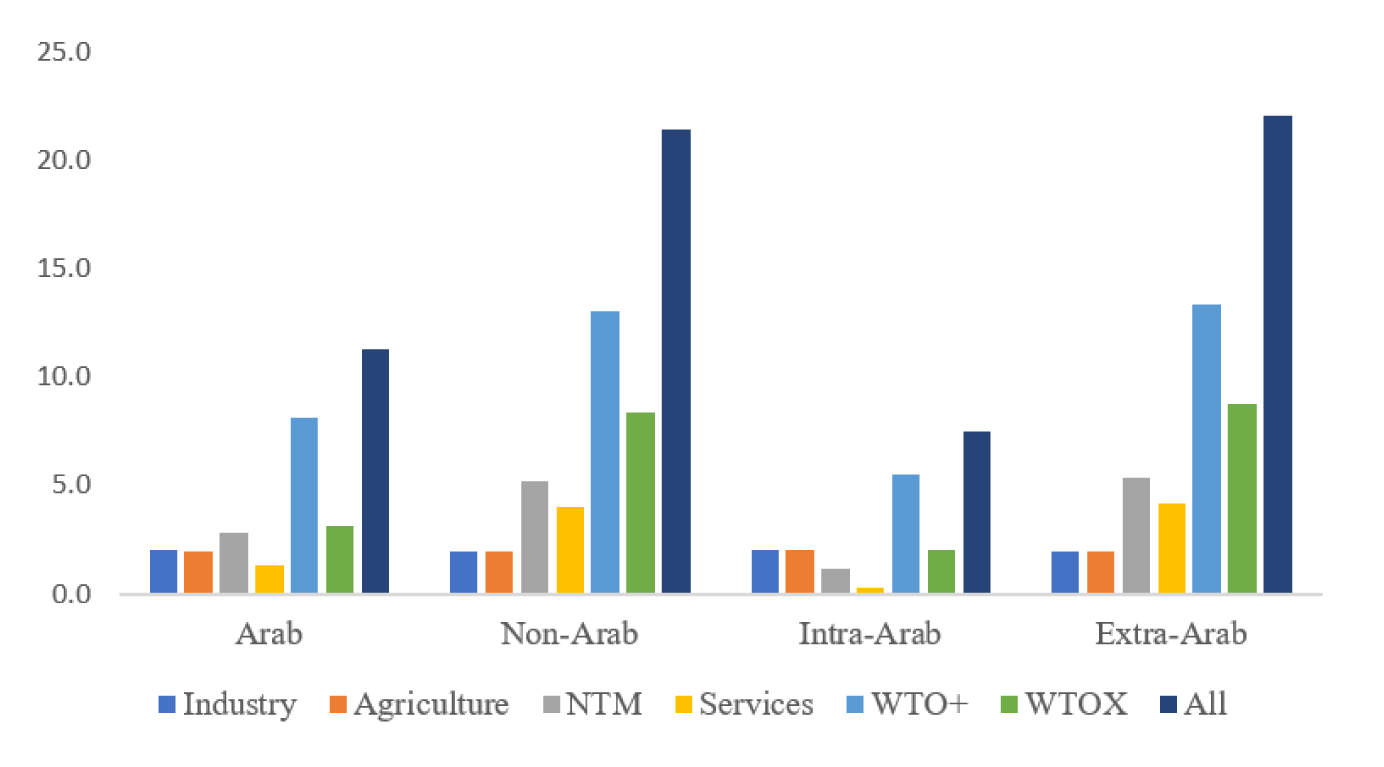
Notes: (i) The figures show the average number of provisions included in trade agreements; (ii) Arab refers to the case of agreements involving Arab exporters; non-Arab refers to those involving non-Arab exporters; intra-Arab refers to agreements involving Arab exporters and importers; extra-Arab refers to agreements involving non-Arab exporters and importers.
Towards a resilient food future
As climate change, geopolitical uncertainty and supply chain disruptions continue to reshape global food markets, MENA countries will need to move beyond crisis management towards long-term resilience.
Achieving this objective requires several complementary policy actions:
- Diversifying cereal import sources.
- Monitoring supplier concentration and supply chain risks through early warning systems that help governments to anticipate shocks before they escalate.
- Supporting domestic agriculture through productivity-enhancing investments rather than relying primarily on border protection.
- Reducing unnecessary trade costs by streamlining customs procedures, simplifying non-tariff measures and improving logistics and transport services.
- Deepening regional and Mediterranean trade integration beyond tariff liberalisation, particularly through regulatory cooperation, harmonised food safety standards, digital customs systems and improved transport connectivity.
Together, these measures would help to transform trade policy from a short-term crisis response into a long-term strategy for strengthening food security and reducing MENA’s vulnerability to external shocks.
Further reading
Aboushady, N, and C Zaki (2025) ‘Building sustainable food supply chains through trade policy in Western Asia and Northern Africa’, UNCTAD Development Account Project – 16th tranche, Geneva.
Bairati L, Y Forouheshfar, F Karam, A Khafagy, D Moawad, P Pazos Puig, I Perez Borda, G Proglio, M Ruiz de Cossío, D Saccone and C Zaki (2026) ‘Resilience-enhancing trade policies reducing MENA dependency on non-Mediterranean countries’, STAPLES project, deliverable 2.1.
United States Department of Agriculture (2022a) ‘Food and Agricultural Import Regulations and Standards Export Certificate Report – Algeria’, FAIRS Export Certificate Report.
United States Department of Agriculture (2022b) ‘Food and Agricultural Import Regulations and Standards Export Certificate Report – Egypt’, FAIRS Export Certificate Report.
United States Department of Agriculture (2022c) ‘Food and Agricultural Import Regulations and Standards Export Certificate Report – Jordan’, FAIRS Export Certificate Report.
This column is part of the STAPLES (STable food Access and Prices and Lower Exposure to Shocks) project, which addresses critical issues of food security in the MENA region, where countries heavily rely on cereal imports for their population’s dietary needs. It is a PRIMA project funded by the EU.