

In a nutshell
Turkey implemented an extensive programme in the 2000s to expand the lane capacity of existing roads; the goal was to improve safety and the reliability of travel times over the national transport grid through investments across the country.
Between 2005 and 2015, the average travel time between any two districts was reduced by 1.4 hours, relative to the initial average of 9.8 hours; time savings increased for districts further apart, reaching an average of three hours for districts 1,500km apart.
Improvements in domestic market access via reduced travel times have had a positive effect on aggregate employment at the district level, boosting the ratio of local employment to population without increasing population.
High transport costs can cause spatial disparities in economic activity by impeding market access in isolated regions, both in terms of firms’ ability to sell goods and in terms of their ability to buy the required inputs. Investment in transport infrastructure can affect regional inequality and improve growth prospects by facilitating trade. But how large are these gains, especially when there are various types or stages of investments that are possible?
The question is harder to answer than one might expect. Infrastructure projects tend to be expensive and long lasting, so governments may prioritise investments in regions already poised for growth. This tends to generate a positive association between infrastructure and income levels, not because the former causes the latter, but because of strategic selection.
Previous work has approached the question of road investments through cross-country analysis (Limao and Venables, 2001; Yeaple and Golub, 2007), or focused on new construction in the context of developed countries (Duranton et al, 2014; Allen and Arkolakis, 2014; Jaworski and Kitchens, 2019) and developing countries (Faber, 2014, on the highway network in China; Asturias et al, 2018, on the Golden Quadrilateral highway in India; Kebede, 2019, on improved village roads in Ethiopia).
Jaworski et al (2020) demonstrate the substantial role of the US interstate highway system in promoting international trade linkages. In a similar context, Gibbons et al (2017, 2019), find that new road construction in the UK spurred the creation of new firms nearby and promoted the productivity of existing ones.
We complement the existing evidence by offering new empirical and quantitative evidence on the benefits of a major capacity upgrade to existing transport infrastructure in middle-income economies using rich spatially disaggregated data.
In our recent research (Coşar et al, 2021), we study the impact of road capacity upgrades on aggregate and regional outcomes in Turkey. Turkey implemented an extensive programme in the 2000s to expand the lane capacity of existing roads. The goal was to improve safety and the reliability of travel times over the national transport grid through investments across the country.
Specifically, a substantial share of existing two-lane single-carriageways with two-way traffic was upgraded to dual carriageways separated by a small earthen medium, with two-lane one-way traffic on each carriageway.
The share of national roads accounted for by the upgraded dual carriageways reached 35% by 2015, up from just 10% in 2002. Meanwhile, the overall length of roadways remained relatively flat. The maps in Figure 1, digitised from those published by Turkey’s General Directorate of Highways, show the extent of upgrades between 2005 and 2015.
Figure 1: Turkish districts and roads
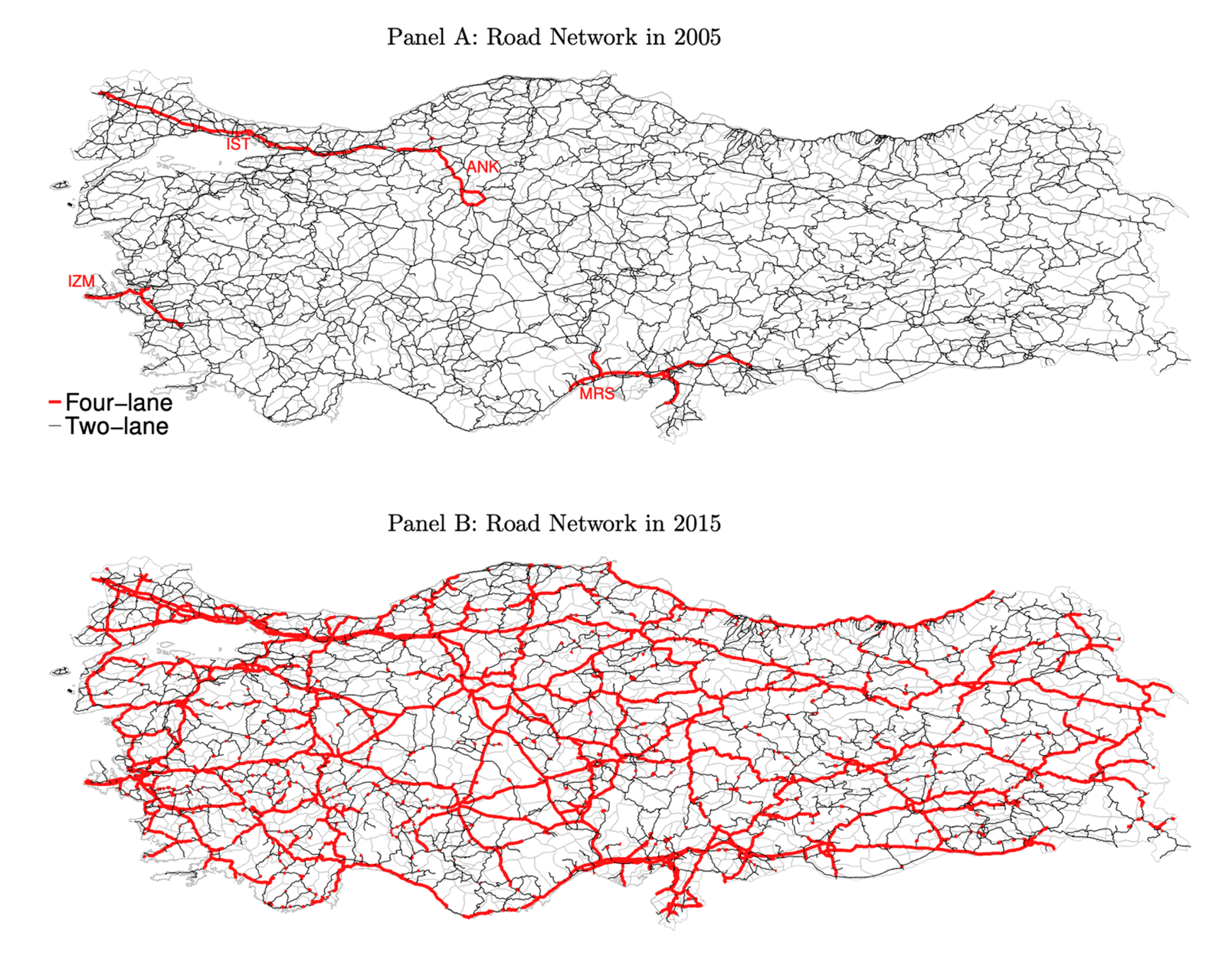
What was the impact of this significant improvement in the quality and lane capacity of the existing paved road network on intra-national trade and regional economic outcomes? We begin by examining the ten-year change in bilateral trade (from 2006 to 2016) against the reduced travel times (from 2005 to 2015).
Constructing the data for analysis
We construct measures of domestic trade from administrative firm-to-firm transaction data provided by the Turkish Ministry of Industry and Technology. We use annual bilateral trade flows of goods between Turkey’s 913 districts, generated from domestic sales of firms that operate in manufacturing and wholesale industries.
Average travel speeds differ across upgraded and non-upgraded road segments, affecting travel times. Using geographic information systems (GIS) software and digitised maps for 2005, 2010 and 2015 (Figure 1), we calculate the fastest routes and total travel times between all districts for road networks as they existed in each year.
There is considerable decrease in district-pair level travel times reductions over time: from 2005 to 2015, the average travel time between any two districts has been reduced by 1.4 hours, relative to the initial average of 9.8 hours. Time savings increase the further apart districts are, reaching three hours, on average, in the case of districts that are 1,500km apart.
Reduced travel times and trade
For the analysis, we use trade flows between very disaggregated geographical units, which are small and unlikely to have been targeted for investments. Through fixed effects, we control for bilateral pairs of larger geographical administrative units at the level that one may be concerned about selection.
We find that a one-hour reduction in travel time between two districts with positive trade in 2005 increases bilateral trade between those districts by around 8.2%. This effect is statistically significant and translates into an almost US$1 million increase in trade flows for a typical supplier district over ten years.
Looking at the effect on establishing new trade relationships in the extensive margin, we find that a district pair that experienced a one-hour decline in travel time had a probability of 11% to start trading in 2016. In short, the positive effect was economically significant in both the intensive and extensive margin.
Road capacity and regional outcomes
To investigate how the reduction in travel times affects regional outcomes, we construct a measure of improved domestic market access for each district to all other districts, weighted by 2005 populations. We estimate that improvements in domestic market access have a positive effect on aggregate employment at the district level.
This is especially beneficial for employment in manufacturing and wholesale. For a district with average connectivity in 2005, we find that a one standard deviation increase in connectivity increases employment in goods-trading industries by 10.2 log points, which corresponds to slightly more than 15% of the average district-level employment growth in those industries between 2006 and 2016.
What is the impact on wellbeing?
Building on our reduced-form results, we calibrate a spatial equilibrium model with trade à la Allen and Arkolakis (2014) to quantify the impact of road upgrades on welfare using district level data. We estimate short-run population-weighted aggregate welfare gains due to the road upgrades of about 2.69%. The long-run welfare gains are only slightly higher, which points to changes in market access rather than reallocations of labour as the main driver of the overall impact. Most gains appear to be realised in the short run.
Increasing employment but not population
A key finding in our reduced form investigation concerns the responses of local employment and population to road investments. We find that improved domestic market access strongly increases a district’s ratio of local employment to population while exerting a null effect on its population. To speak to this result, we extend Allen and Arkolakis (2014) to feature endogenous local labour supply.
The extended model features additively separable consumption and labour supply decisions. This allows an endogenously determined local labour supply to differ from the population size and respond to changes in trade costs, even when population is immobile in the short run.
Another novel element of the model is location-specific disutility of work, which is necessary to fit the variation in employment rates across locations. We interpret this last measure as a reduced form means of capturing persistent local factors that affect participation in the formal labour force, including preferences for female labour force participation, which we show is positively affected by improved market access.
After establishing sufficient conditions for the existence and uniqueness of equilibrium in the extended model, and calibrating its additional parameters, we compare model-generated outcomes with relevant empirical findings as well as with the baseline model. We estimate the model on data from Turkey’s 81 provinces, which offers an appropriate level for capturing geographical labour markets.
The elasticity by which the province-level employment ratio changes with travel time reductions is estimated at -0.083. To compare this number with its empirical counterpart, we re-estimate the reduced form specification at the province level and find an elasticity of -0.288. So, the model-implied elasticity (-0.083) captures about 30% of the empirical elasticity (-0.288). The extended model is both capable of rationalising its motivating evidence and producing quantitatively relevant results.
Further reading
Allen, T, and C Arkolakis (2014) ‘Trade and the Topography of the Spatial Economy’, Quarterly Journal of Economics.
Asturias, J, R Ramos and MG Santana (2018) ‘Competition and the Welfare Gains from Transportation Infrastructure: Evidence from the Golden Quadrilateral in India’, Journal of the European Economic Association.
Coşar, AK, B Demir, D Ghose and N Young (2021) ‘Road Capacity, Domestic Trade and Regional Outcomes’, NBER Working Paper No. 29228.
Duranton, G, P Morrow and MA Turner (2014) ‘Roads and Trade: Evidence from the US’, Review of Economic Studies.
Faber, B (2014) ‘Trade Integration, Market Size, and Industrialization: Evidence from China’s National Trunk Highway System’, Review of Economic Studies.
Gibbons, S, T Lyytikäinen, HG Overman and R Sanchis-Guarner (2019) ‘New road infrastructure: The effects on firms’, Journal of Urban Economics 110: 35-50.
Gibbons, S, T Lyytikäinen, HG Overman and R Sanchis-Guarner (2017), ‘New road infrastructure: The effects on firms‘, VoxEU.org, 27 July.
Jaworski, T, C Kitchens and S Nigai (2020) ‘Highways and Globalization’, NBER Working Paper No. 27938.
Jaworski, T, C Kitchens and S Nigai (2020) ‘Globalisation and the value of domestic highway infrastructure‘, VoxEU.org, 1 November.
Kebede, H (2019) ‘The gains from market integration: The welfare effects of rural roads in Ethiopia’, mimeo, University of Virginia.
Limao, N, and AJ Venables (2001) ‘Infrastructure, Geographical Disadvantage, Transport Costs, and Trade’, World Bank Economic Review 15(3): 451-79.
Yeaple, S, and S Golub (2007), ‘International Productivity Differences, Infrastructure, and Comparative Advantage’, Review of International Economics 15(2): 223-42.
This column was first published on VoxEU.