

Economic Research Forum (ERF)

Student protests in 1970s Turkey: the impact on later lives

2878
From the Arab Spring to the ‘gilets jaunes’ in France and from anti-Revolution protests in Iran to Hong Kong’s umbrella revolution, it is common to see mass socio-political movements in the early twenty-first century. This column looks back to earlier uprisings – the Turkish student protests that took place between 1978 and 1980 and eventually led to a military coup in 1980 – to explore how exposure to violent political turmoil affects people’s educational and labour market outcomes later in life.

In a nutshell

Universities and other higher education institutions were at the centre of the civil conflict in Turkey from 1960 to 1980.

The number of new admissions and graduates in post-secondary education declined significantly due to the intense violence seen in the late 1970s in Turkey.

Individuals who would have otherwise completed a post-secondary degree would have earned much more than their actual earnings if the turmoil had never occurred.

The mass socio-political uprisings of the early twenty-first century have similarities with the student movements of the 1960s and early 1970s, which became a global phenomenon. In the United States and Europe, these movements had declined significantly by the mid-1970s (Barker, 2012), the same time at which Turkey’s protests started to mutate into violence.

Our study presents a comprehensive empirical analysis of the education and labour market consequences of this political turmoil on cohorts of young people directly exposed to educational disruptions (Ozturk and Tumen, 2019):

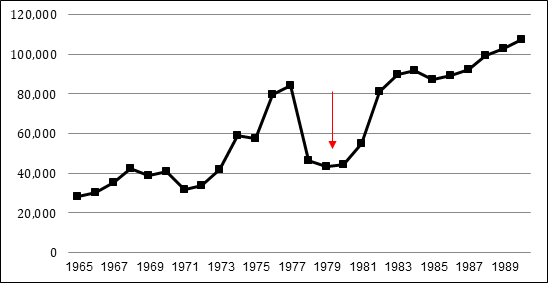
  • First, we document that new enrolments in post-secondary education declined in the 1978/79 school year, largely due to the closure of teacher training institutes driven by their links to student violence.
  • The second channel that adversely affected educational attainment was that graduation rates declined following massive student dropouts related to security concerns.
  • Finally, mass student arrests in the wake of the 1980 coup kept many from completing their education.

Figure 1 demonstrates this dramatic decline based on data covering the period from 1965 to 1990. Using the 2005-2008 waves of the Turkish Household Labor Force Survey, we estimate that the decline in post-secondary graduation ratio was around 6.5 percentage points for the exposed individuals.

Figure 1: New enrolments in all higher education institutions in Turkey from 1965 to 1990
Source: Authors’ calculations based on the National Education Statistics, Higher Education and Academic Year Higher Education Statistics books.

We use the decline in post-secondary education as a natural experiment and design an ‘instrumental variable’ strategy based on exposed versus non-exposed cohorts to estimate the effect of post-secondary education on labour market earnings.

Our estimates suggest that the returns to a four-year college degree are around 56-58 log points for men. This corresponds to around 15% returns to an additional year of post-secondary education. Our findings are robust to using alternative birth-cohort specifications in defining the treatment and control groups.

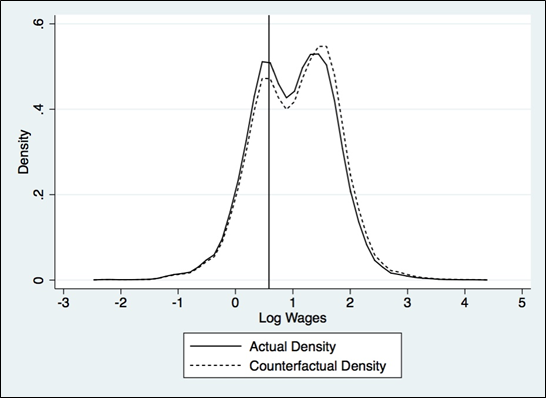
We also analyse the impact of the political turmoil on the wage distribution of exposed individuals. The estimates of the counterfactual and the actual densities are represented in Figure 2. The vertical line indicates the log minimum wage.

Figure 2: The actual and counterfactual density of log wages for the exposed group
 

Notes: The sample includes male wage earners aged 40-51. Observations are weighted using the sampling weights so that the results are nationally representative.

The difference between the actual and counterfactual densities represents the effect of the decline in post-secondary educational attainment – due to the political turmoil – on the distribution of wages for the exposed group.

Strikingly, the decline in post-secondary education pushes these individuals from the higher-income group towards the minimum-wage group. Those individuals who would have otherwise completed a post-secondary degree would have earned much more than their actual earnings if the turmoil had never occurred. We also show that the exposed cohorts are less likely to choose high-wage occupations.

These findings suggest that violent political turmoil and other large-scale turbulent events affecting large fractions of the productive population generate persistent negative consequences on long-term outcomes that directly measure the wellbeing of individuals.

Further reading

Ahmad, F (1993) ‘The Making of Modern Turkey’, Routledge.

Barker, C (2012) ‘Some Reflections on Student Movements of the 1960s and Early 1970s’, Revista Critica de Ciencias Sociais 81: 43-91.

Gunter, MM (1989) ‘Political Instability in Turkey during the 1970s’ Conflict Quarterly 9: 63-77.

Maurin, E, and S McNally (2008) ‘Vive la Revolution! Long-term Educational Returns of 1968 to the Angry Students’, Journal of Labor Economics 26: 1-33.

Ozturk, A, and S Tumen (2019) ‘Education and Labor Market Consequences of Student Protests in Late 1970s and the Subsequent Military Coup in Turkey’, ERF Working Paper No. 1377.


Most read

Sanctions and the shrinking size of Iran’s middle class

International sanctions imposed on Iran from 2012 have reduced the size of the country’s middle class, according to new research summarised in this column. The findings highlight the profound social consequences of economic pressure, not least given the crucial role of that segment of society for national innovation, growth and stability. The study underscores the need for policies to safeguard the civilian population in countries targeted by sanctions.

Artificial intelligence and the renewable energy transition in MENA

Artificial intelligence has the potential to bridge the gap between abundant natural resources and the pressing need for reliable, sustainable power in the Middle East and North Africa. This column outlines the constraints and proposes policies that can address the challenges of variability of renewable resources and stress on power grids, and support the transformation of ‘sunlight’ to ‘smart power’.

Green jobs for MENA in the age of AI: crafting a sustainable labour market

Arab economies face a dual transformation: the decarbonisation imperative driven by climate change; and the rapid digitalisation brought by artificial intelligence. This column argues that by strategically managing the green-AI nexus, policy-makers in the region can position their countries not merely as followers adapting to global mandates but as leaders in sustainable innovation.

Egypt’s forgotten democratisation: a challenge to modern myths about MENA

A widely held narrative asserts that countries in the Middle East are inevitably authoritarian. This column reports new research that tracks Egyptian parliamentarians since 1824 to reveal that the region’s struggle with democracy is not in fact about cultural incompatibility: it’s about colonialism disrupting home-grown democratic movements and elite conflicts being resolved through disenfranchisement rather than power-sharing.

MENA integration into global value chains and sustainable development

Despite the geopolitical advantages, abundant natural resources and young populations of many countries in the Middle East and North Africa, they remain on the periphery of global value chains, the international networks of production and service activities that now dominate the world economy. This column explains the positive impact of integration into GVCs on exports and employment; its role in technology transfer and capacity upgrading; and the structural barriers that constrain the region’s involvement. Greater GVC participation can help to deliver structural transformation and sustainable development.

Arab youth and the future of work

The Arab region’s labour markets are undergoing a triple transformation: demographic, digital and green. As this column explains, whether these forces evolve into engines of opportunity or drivers of exclusion for young people will hinge on how swiftly and coherently policy-makers can align education, technology and employment systems to foster adaptive skills, inclusive institutions and innovation-led pathways to decent work.

Wrong finance in a broken multilateral system: red flags from COP30-Belém

With the latest global summit on climate action recently wrapped up, ambitious COP pledges and initiatives continue to miss delivery due to inadequate commitments, weak operationalisation and unclear reporting systems. As this column reports, flows of climate finance remain skewed: loans over grants; climate mitigation more than climate adaptation; and weak accountability across mechanisms. Without grant-based finance, debt relief, climate-adjusted lending and predictable multilateral flows, implementation of promises will fail.

Why political connections are driving business confidence in MENA

This column reports the findings of a new study of how the political ties of firms in the Middle East and North Africa boost business confidence. The research suggests that this optimism is primarily driven by networked access to credit and lobbying, underscoring the need for greater transparency and institutional reform in corporate governance.

Digitalising governance in MENA: opportunities for social justice

Can digital governance promote social justice in MENA – or does it risk deepening inequality and exclusion? This column examines the evolution of digital governance in three sub-regions – Egypt, Jordan and the countries of the Gulf Cooperation Council – highlighting how data practices, transparency mechanisms and citizen trust shape the social outcomes of technological reform.