

Economic Research Forum (ERF)

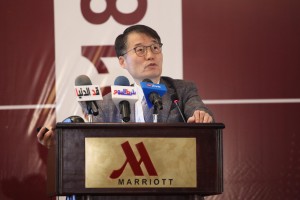
Keun Lee

Author

Keun Lee
Professor of Economics at the Seoul National University

Keun Lee is a Professor of Economics at the Seoul National University, and the winner of the 2014 Schumpeter Prize for his monograph on Schumpeterian Analysis of Economic Catch-up (2013 Cambridge Univ. Press). He is now the President of the International Schumpeter Society, a member of the Committee for Development Policy of UN, an editor of Research Policy, an associate editor of Industrial and Corporate Change, and a council member of the World Economic Forum. He obtained his Ph.D. in economics from the University of California, Berkeley, and has working experience at the World Bank, University of Aberdeen, and the East West Center, Hawaii. One of his most cited articles is a paper on Korea’s Technological Catch-up published in Research Policy, with 1,000 citations (Google Scholar). His H-index is now 35, with 85 papers with more than 10 citations.

Content by this Author

Escaping the middle-income trap: lessons from East Asia’s experience

Many countries find themselves in the ‘middle-income trap’, facing a slowdown of economic growth because of weak innovation. This column draws on the experiences of East Asian countries to explore how businesses can upgrade their innovation capabilities and how policies can provide support for those efforts, thereby promoting renewed growth. There are important lessons for the MENA region.

Most read

Private capital and financial innovation in Egypt’s clean energy transition

The Benban Solar Park, Africa’s biggest photovoltaic power station, demonstrates Egypt’s ability to attract foreign investment, implement complex infrastructure projects and align its energy goals with environmental sustainability. As this column explains, the next stage of the country’s clean energy transition requires a diversified financial ecosystem, together with committed and well-coordinated policy support.

Sanctions and the shrinking size of Iran’s middle class

International sanctions imposed on Iran from 2012 have reduced the size of the country’s middle class, according to new research summarised in this column. The findings highlight the profound social consequences of economic pressure, not least given the crucial role of that segment of society for national innovation, growth and stability. The study underscores the need for policies to safeguard the civilian population in countries targeted by sanctions.

The rising threat of water and food insecurity in MENA

The Middle East and North Africa is rapidly becoming the global epicentre of water and food insecurity. Drawing on regional evidence and global comparisons, this column identifies urgent priorities and offers policy strategies to strengthen resilience in this particularly climate-stressed part of the world before the crisis deepens further. The tools exist: what is needed is the political will and coordinated action to use them.

Artificial intelligence and the renewable energy transition in MENA

Artificial intelligence has the potential to bridge the gap between abundant natural resources and the pressing need for reliable, sustainable power in the Middle East and North Africa. This column outlines the constraints and proposes policies that can address the challenges of variability of renewable resources and stress on power grids, and support the transformation of ‘sunlight’ to ‘smart power’.

Green jobs for MENA in the age of AI: crafting a sustainable labour market

Arab economies face a dual transformation: the decarbonisation imperative driven by climate change; and the rapid digitalisation brought by artificial intelligence. This column argues that by strategically managing the green-AI nexus, policy-makers in the region can position their countries not merely as followers adapting to global mandates but as leaders in sustainable innovation.

MENA integration into global value chains and sustainable development

Despite the geopolitical advantages, abundant natural resources and young populations of many countries in the Middle East and North Africa, they remain on the periphery of global value chains, the international networks of production and service activities that now dominate the world economy. This column explains the positive impact of integration into GVCs on exports and employment; its role in technology transfer and capacity upgrading; and the structural barriers that constrain the region’s involvement. Greater GVC participation can help to deliver structural transformation and sustainable development.

Egypt’s forgotten democratisation: a challenge to modern myths about MENA

A widely held narrative asserts that countries in the Middle East are inevitably authoritarian. This column reports new research that tracks Egyptian parliamentarians since 1824 to reveal that the region’s struggle with democracy is not in fact about cultural incompatibility: it’s about colonialism disrupting home-grown democratic movements and elite conflicts being resolved through disenfranchisement rather than power-sharing.


Linkedin